Profile view of a bearded man wearing a black baseball cap and a dark gray T-shirt against a plain light background.

Why your furnace whistles in New Mexico

RepairFurnace or heatingNew Mexico
Step 1 of 2

What ZIP code is the job in?

A whistling furnace almost always means air is squeezing through somewhere too narrow for it, usually the filter. A clogged filter forces the blower to pull air past it through a small gap, and that's what makes the high thin sound you're hearing, often right at the return vent or the furnace cabinet itself. A closed or half-closed supply vent in another room can do the same thing, since the air still has to go somewhere. Less often, the whistle comes from a cracked duct seam or a gap around the blower door, where air is leaking out instead of moving where it should. In New Mexico, dust gets pulled into return air easily, especially after a dry, windy stretch, which clogs filters faster than people expect. A furnace that's whistling isn't about to fail outright, but it's working harder than it needs to, and a restriction that's bad enough to whistle is bad enough to wear on the blower motor over a full winter.

A gray high-efficiency furnace with white PVC vent pipes stands against a concrete basement wall beside sheet-metal ductwork, a small condensate pump on the floor, and exposed wood framing at left.
A clean filter seated right lets air move through the furnace without a sound.
A gray sheet-metal furnace with flue pipe and adjacent ductwork stands against a stone basement wall on a concrete floor, with white PVC and metal pipes running nearby.
A whistle that keeps coming back after you've changed the filter points to something further in.
A man with grey hair and stubble in a dark sweater sits on a grey sofa indoors, looking off to the side, with a potted plant and a sunlit window behind him.
A man with gray hair, a beard and glasses, wearing a dark green sweater, sits on a gray sofa in a sunlit living room with a potted plant, table lamp and wooden sideboard behind him.
A middle-aged man with graying hair and a short beard sits on a blue sofa in a living room, looking toward a window, with a bookshelf, lamp and framed picture in the background.
A man with graying curly hair and a dark green sweater sits on a gray sofa in a sunlit living room, looking off to the side, with a framed picture, shelving, an armchair and a window with sheer curtains behind him.

Why does my furnace still whistle after I changed the filter?

You put in a new filter and the whistle is still there, or it went away for a day and came back. That's confusing when every furnace tip you've read says the filter is the fix. In New Mexico, where furnaces run most of the winter and then sit idle through a hot, dry summer, there's often more going on than a dirty filter, especially if the sound keeps returning on a system that otherwise ran quiet for years.

The whistle is coming from somewhere past the filter

When a new filter doesn't fix it, the air is still squeezing through a gap, just not at the filter rack. A loose panel on the return side, a duct seam that's pulled apart, or a gap where the filter slot doesn't seal tight against the frame can all do it. Dust lines around the filter door are a sign air is leaking in right there instead of passing through the filter itself. A return duct that's undersized for the blower can whistle too, especially if the furnace is working harder than it used to. None of this clears up on its own, and it's worth having someone who services furnaces in New Mexico look at the return side and the ductwork near the unit before the heating season settles in.

A dark interior hallway with a dim window at the end, a wooden floor, a stair railing on the right, and a bench or rug in the foreground.

You're awake before you know why. The house is quiet, the kind of quiet New Mexico nights get in January, dry and still. You lie there a second, then you hear it, or rather you don't, the thin whistle that's been following you around the house all week is gone. No sound from the vents at all. You walk the hallway in sock feet and the floor is cold under you. At the window the frost has crept up the edges of the glass. You hold your hand near the vent and feel nothing coming out of it, not warm air, not the whistle, nothing.

The right pro for this job

A whistle that survives a filter change is telling you something about the duct or the return grille, not the furnace itself, and that's harder to run down over the phone than it is standing next to the unit. Someone who works on furnaces around New Mexico all winter has heard this exact complaint enough times to know where to look first, a return that's too small for the blower, a closed-off room starving the system for air, a duct joint that opened up. That's the kind of thing you find by listening and checking, not guessing from a list of symptoms online. Putting in a request here gets it to one local contractor who takes furnace calls like this every season, not a handful of companies competing for your callback. You've already changed the filter and the sound came back. The next useful step is having someone who knows this equipment look at what's actually feeding that whistle.

A gray gas furnace stands on a concrete basement floor, connected to sheet-metal ductwork, white PVC vent pipes, and a yellow gas line, with plastic sheeting covering the walls.

Running quiet

This is what a furnace should sound like: nothing. Air moves through the filter and the ducts without catching anywhere, so the blower just hums low in the basement. If yours ran like this a month ago, something changed, and that change is worth finding.


A metal furnace with louvered panels stands against a concrete basement wall, connected to sheet-metal ductwork and a round flue pipe, with wooden framing posts and a pipe nearby.

Straining to breathe

Dust has built up around this one for years, and age alone narrows the gaps air needs to move through. A furnace in this shape whistles because something inside is restricting it, and it usually isn't the filter anymore. Someone who works on furnaces like this in New Mexico can tell you what's actually closing in.

Call now or wait it out

Call for repair now

  • A whistle that started suddenly and gets louder points to a blockage or a failing blower, and that tends to get worse, not better, on its own.
  • If the sound comes with the furnace short cycling or blowing cooler air than usual, a contractor can catch what's causing both before a cold snap tests the system hard.
  • A tech who works on furnaces around New Mexico every winter can open the cabinet and tell you in minutes whether it's the blower wheel, a duct gap, or the return grille.
  • Waiting through a whistle means living with the noise and gambling that whatever's narrowing the airflow doesn't strain the blower motor further.
  • A local licensed contractor can check the duct connections and the return side, the parts a homeowner can't easily get to without pulling the furnace apart.

Keep an eye on it

  • A faint whistle that only shows up on the coldest nights, when the furnace runs longest, might just be air moving harder through a slightly undersized return.
  • If you just changed the filter and the sound is already fading, give it a few days before assuming it's something more.
  • A whistle that only happens right when the furnace kicks on, then disappears, is often just ductwork settling as it heats, not a sign of a problem.
  • Tracking when it happens, at startup, mid-cycle, or only on high heat, gives a contractor more to go on if it doesn't clear up.
  • If nothing else about the furnace has changed, no new noises, no change in how warm the house gets, it's reasonable to watch it through a few more cold nights first.
  1. Air gets pulled into the return grille toward the blower.

  2. A narrow gap forces that air to speed up.

  3. Fast air through a tight space starts to vibrate.

  4. That vibration turns into the whistle you hear.

A woman with shoulder-length brown hair wearing a beige knit cardigan sits in a gray upholstered armchair near a window, looking off to the side with a slight smile, with bookshelves blurred in the background.
A woman and a sleeping child wrapped together in a cream knitted blanket on a couch, with a potted plant, framed photo and lit lamp in the background.

Winter nights average 23°F statewide

Winter nights here average 23°F, cold enough that your furnace is running long stretches to keep up, often most of the night. That's extra hours for air to push through whatever gap is causing the whistle, which is why the sound tends to show up, or get worse, once the cold settles in.

NOAA nClimDiv 1991-2020 county normals weighted by homes

A gray high-efficiency furnace in a basement with sheet-metal ductwork, white PVC vent pipes, metal plumbing lines, a condensate pump on the floor, and a window showing green trees outside.

Moving air without a sound

This is a furnace set up the way it should be: ductwork sized for it, lines run clean, nothing pinched. Air gets from the return to the blower and out through the ducts without catching on anything, so the only sound is a low hum from the cabinet.

An older metal furnace with PVC and metal pipes stands on a concrete basement floor beside galvanized ductwork, with wooden stairs and a water tank in the background.

Something in here is restricting it

Dust like this builds up on more than the filter. It settles inside the cabinet, on the blower wheel, along the ductwork. Any of that narrows the path air has to take, and a narrower path is where a whistle starts, whether or not the filter itself is clean.

A woman in a cream cardigan and jeans stands with one hand raised facing an open front door of a gray horizontal-siding house, with a black lantern wall light, a potted shrub with yellow flowers, and a stone-faced porch column.

A whistle has a cause, and it can be found

The sound means air is catching somewhere between the return grille and the blower. A filter fixes that most of the time. When it doesn't, the gap is further in, at the grille, a duct joint, or the blower housing itself, and finding it means someone standing at your furnace, not guessing over the phone.

A furnace running most of a winter night in New Mexico cold will make that gap louder before it makes it go away on its own. Someone local who works on furnaces all winter here has heard this exact whistle before and knows where to look first. You'd be matched with one contractor who takes on your furnace specifically, not a handful of companies working the same lead.

A living room corner with a light beige sofa holding a textured taupe cushion, a large ceramic vase of olive branches by a window, a framed neutral artwork on the wall, and a dark bowl with stacked books in the foreground.
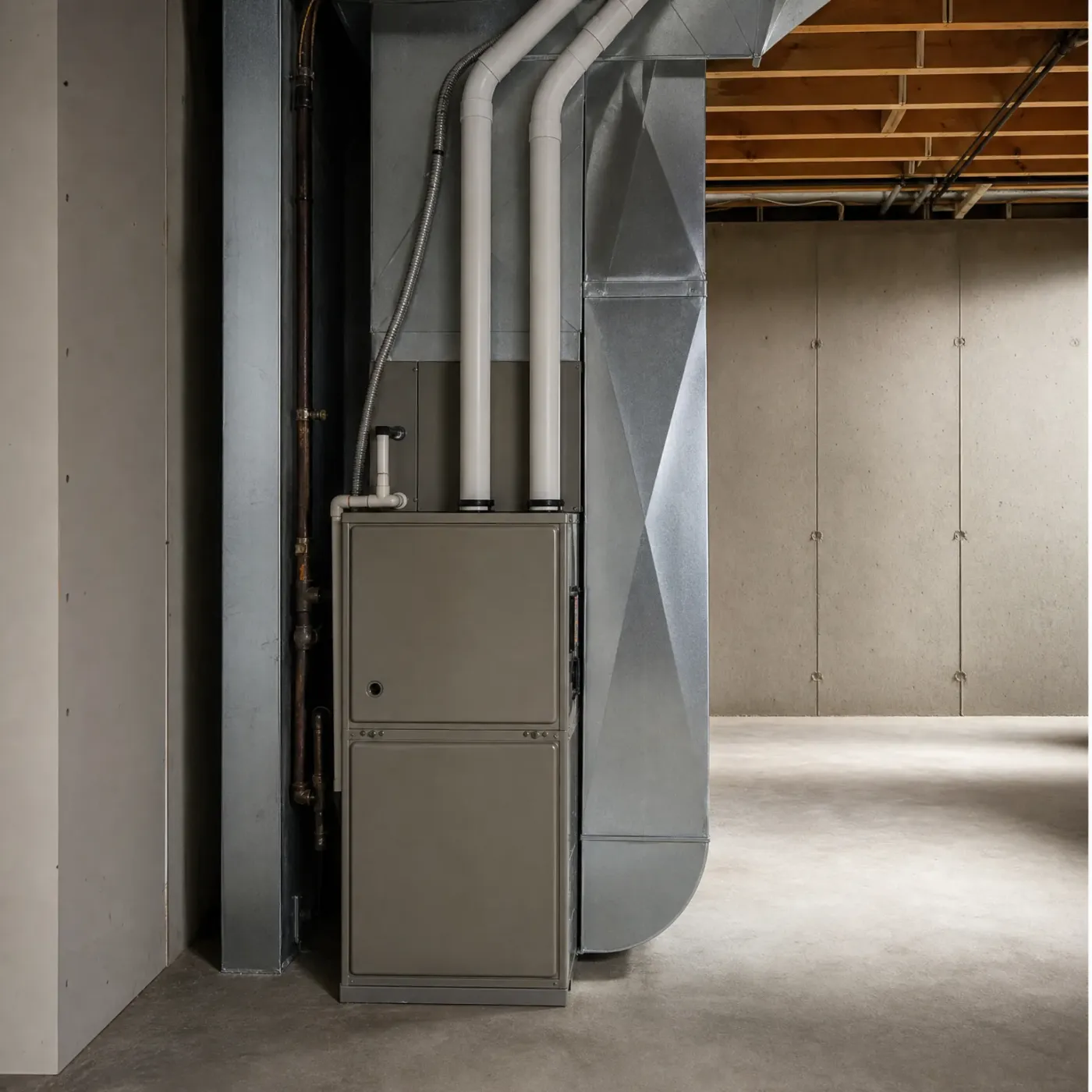
A gray high-efficiency furnace in an unfinished basement, connected to sheet-metal ductwork and two white PVC vent pipes, with copper piping and exposed wood floor joists nearby.

Matched to your furnace job

Find a local pro

Your request stays with one local pro.

Sending the form costs nothing.