





A flat-roofed adobe house lit from within at dusk, surrounded by saguaro cacti and desert landscaping with mountains in the background.

Heat Pump Repair in Socorro, NM

Tell us about the job

Takes about a minute. No obligation.

RepairHeat PumpSocorro County, NM
Step 1 of 2

What ZIP code is the job in?

Winter nights here average 23°F across December, January and February. That's cold enough that your heat pump runs its defrost cycle often through those months, and that's normal wear, not bad luck. Socorro County gets its share of wind, and hail shows up most years. None of that is harder on a heat pump than what these systems handle anywhere else. So when yours trips a fault code or stops putting out warm air, the cause is usually an ordinary one. A low charge. A failing defrost board. A dirty outdoor coil. A tech who checks the actual part instead of guessing will find it faster than you'd think.

7 months
October through April, your system heats
3 months
June through August, it cools
23°F
the average winter night it heats against
88°F
the average summer afternoon it cools against
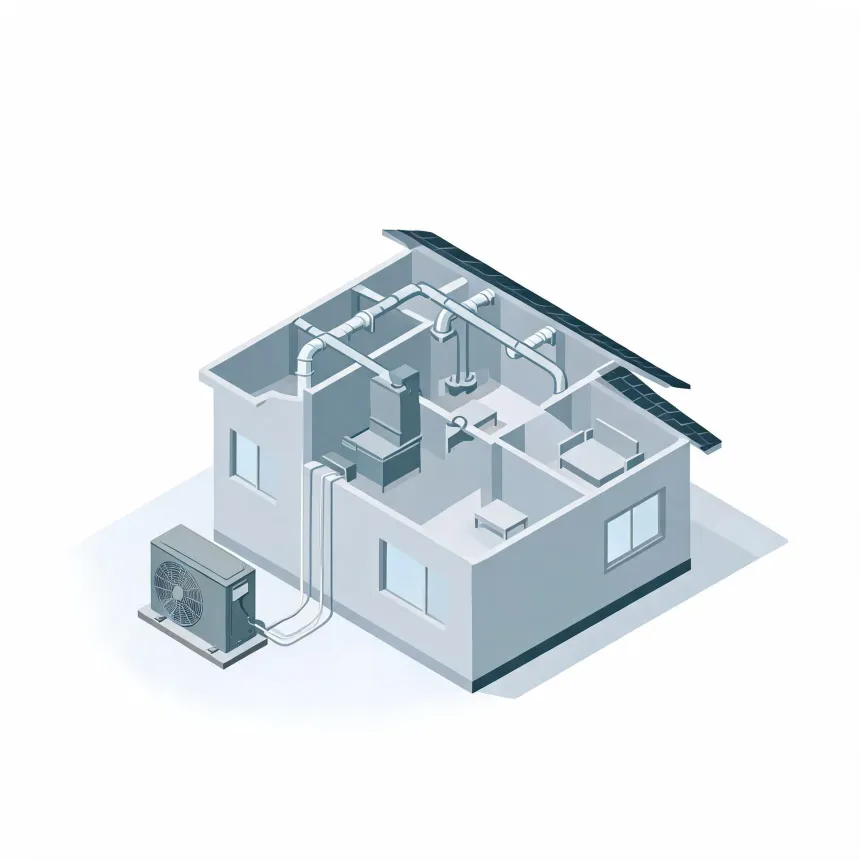
Isometric cutaway illustration of a single-story house showing interior ductwork, an air handler and rooms, with an outdoor condenser unit connected by refrigerant lines on a plain white background.
Your system heats October through April and cools June through August.

NOAA nClimDiv, 1991–2020 normals

Heat here starts up in October.

If your heat pump has a weak part left over from last winter, the first cold nights in September and October are when it shows up.

Socorro doesn't run heat pumps any harder than anywhere else

Power costs 14.2 cents a kWh statewide
132 damaging wind events from 2015 to 2024
26 hail events from 2015 to 2024
Half the homes here are old enough that the heat pump may be tooHalf the homes in Socorro County were built in 1980 or earlier.

Before you call, go outside and look at the outdoor unit. If ice is built up on the coil and it's not running a defrost cycle, clear away any leaves or debris blocking the sides and see if airflow is the problem. Check the air filter inside too. A clogged filter starves the system of airflow and can make it seem like the heat pump itself is failing when it isn't. Look at the thermostat and make sure it's set to heat, not auto or cool, and that the batteries aren't dying if it uses them. If you've got a breaker panel you can check safely, see if the breaker for the outdoor unit has tripped. None of this fixes a bad capacitor or a low refrigerant charge, but it rules out the easy stuff first.

Ask how much life is left before you fix it

If your heat pump came with the house and the house was built in 1980 or earlier, ask the tech how much life is left in it before you go ahead with the repair. A unit that old may be close to the end regardless of what's failing right now. Worth knowing before you decide what to fix.

Find a contractor
A residential heat pump outdoor unit mounted on a concrete pad next to a house with gray vinyl siding.

Running it through the problem rarely fixes the problem

A heat pump that's struggling still tries to meet the thermostat setting, so it keeps calling for more. A weak capacitor makes the compressor draw harder to start each cycle, and every hard start wears the windings a little more until it doesn't start at all. A low charge makes the compressor work against pressures it wasn't built for, and heat that should go to warming the coil goes into the compressor instead. A failing defrost board can leave the outdoor coil icing over a little more each cycle, and once airflow through that coil drops, the system stops moving heat efficiently at all. None of this takes a season. It takes however many hours the system runs trying to do a job it can no longer do cleanly.

The reversing valve is the part unique to this machine

A furnace never has to switch direction. Your heat pump does, every time it goes from heating to defrost and back, and the reversing valve is what makes that switch happen. When it sticks partway, the system can start blowing cold air during a heat cycle, or it can get stuck running defrost long after the coil is clear. That valve takes a kind of wear a straight heating or cooling system never sees.

Most failures trace back to the compressor, even when something else trips first

The compressor is the one part that can't be patched. A failing capacitor, a low charge, a dirty coil choking airflow, all of those put extra strain on the compressor until it's the thing that finally gives out. That's why a tech chasing a fault code is usually trying to catch the real problem before the compressor pays for it.

Most of the time the first sign isn't a dead system. It's one that's working harder than it should to do the same job. Air coming from the vents that feels cool instead of warm, even though the system is running. Longer cycles, or cycles that start and stop more than they used to. A hissing or bubbling sound near the outdoor unit, which usually points to refrigerant rather than anything mechanical. Ice on the outdoor coil that doesn't clear during defrost, instead of the light frost that melts off on its own. A burning or electrical smell from either unit means stop and call, not wait and see. Any fault code or blinking light on the thermostat is the system telling you what's wrong before you have to guess.

Repair makes sense when one part failed and everything else in the system still works the way it should. A capacitor, a contactor, a defrost board, a fan motor, these are parts a tech replaces on their own without touching the rest of the unit, and a heat pump that's otherwise sound goes back to normal once that one part is swapped. Replacement starts to make more sense when the compressor itself is the problem, since that's the part a repair can't touch. It also makes sense when the same unit keeps coming back with a different failure every year, because that pattern usually means the system as a whole is wearing out, not just the part that happens to be broken this time. A tech who's inside the unit can tell you which situation you're in. That's worth more than guessing from the symptom alone.