






View from a shaded covered porch of a single-story stucco house with a recessed entry, gravel ground cover, a concrete block wall, and a large multi-trunked tree under an overcast sky.

Heat Pump Repair in Ruidoso, NM

Tell us about the job

Takes about a minute. No obligation.

RepairHeat PumpLincoln County, NM
Step 1 of 2

What ZIP code is the job in?

October is when heat pumps in Lincoln County earn their keep, and it's also when a weak one gets found out. A capacitor or contactor that was already marginal all summer can't keep up once the unit has to run longer and work harder to pull heat out of cold air. If yours is short cycling, running constantly, or blowing air that isn't quite warm enough, that's not a new problem showing up, it's an old one finally getting tested. Heat pumps here run all the way through April, so a repair now holds for the whole season ahead, not just the next cold snap.

7 months
October through April, your system heats
3 months
June through August, it cools
24°F
the average winter night it heats against
87°F
the average summer afternoon it cools against
Isometric grayscale illustration of a cutaway single-story house showing interior rooms, ductwork and an air handler, an exterior condenser unit connected by lines, and dark solar panels on the roof.
Your system heats October through April and cools June through August.

NOAA nClimDiv, 1991–2020 normals

Lincoln County sees its share of wind, hail and winter storms, same as most of this region.

None of that is what wears out a heat pump. Cold nights and a long season of real use do that job on their own.

Power costs the same here as anywhere, and so does a worn-out part

Power costs 14.2 cents a kWh statewide
138 damaging wind events from 2015 to 2024
51 hail events from 2015 to 2024

Half the homes in Lincoln County were built in 1985 or earlier, half in 1985 or later. That split matters more for the ductwork and wiring feeding a heat pump than for the unit itself. An older house can run a brand new heat pump just fine if the electrical and the return were sized for it, or it can hold back a good unit if they weren't. Mobile homes are close to a quarter of the housing stock here, and those often run a package unit with a different duct setup than a site-built house, which changes where a tech starts looking. None of that points to anything wrong with your equipment. It just means the real fix depends on what the heat pump is tied into, not on this county's weather.

The cause is likely in the unit, and it's fixable

A heat pump that's short cycling or running constantly in Lincoln County almost always comes down to a worn part doing a hard job, not the weather it sits in. Finding which part, and fixing it before the next cold stretch, is what gets the warm air back.

Find a contractor
A man in a cap, gray long-sleeve shirt and tan work pants carries a worn canvas tool bag up porch steps toward a dark gray front door beside a potted shrub.
A residential heat pump outdoor unit mounted on a concrete pad next to a house with gray vinyl siding.

A struggling heat pump gets worse the longer it runs

A heat pump that's struggling doesn't fail cleanly. It fails slower, and running it while it struggles usually makes the eventual repair worse. A weak capacitor forces the compressor to draw more current to start each cycle, and that extra draw is what burns out a compressor that would otherwise have kept going. Short cycling does something similar. Every stop and start is harder on the system than one steady run would be. Ice works differently but ends up in the same place. A failing reversing valve or defrost control lets frost build on the outdoor coil instead of clearing it, and once the coil ices over the unit can't pull heat from the air at all, so it leans on backup heat strips to make up the difference, if it has them. At that point the compressor is working against a blocked coil every time it cycles on. None of this means shut the system off and wait. It means the part that's struggling now is worth having looked at before it takes something else down with it.

What you can check yourself

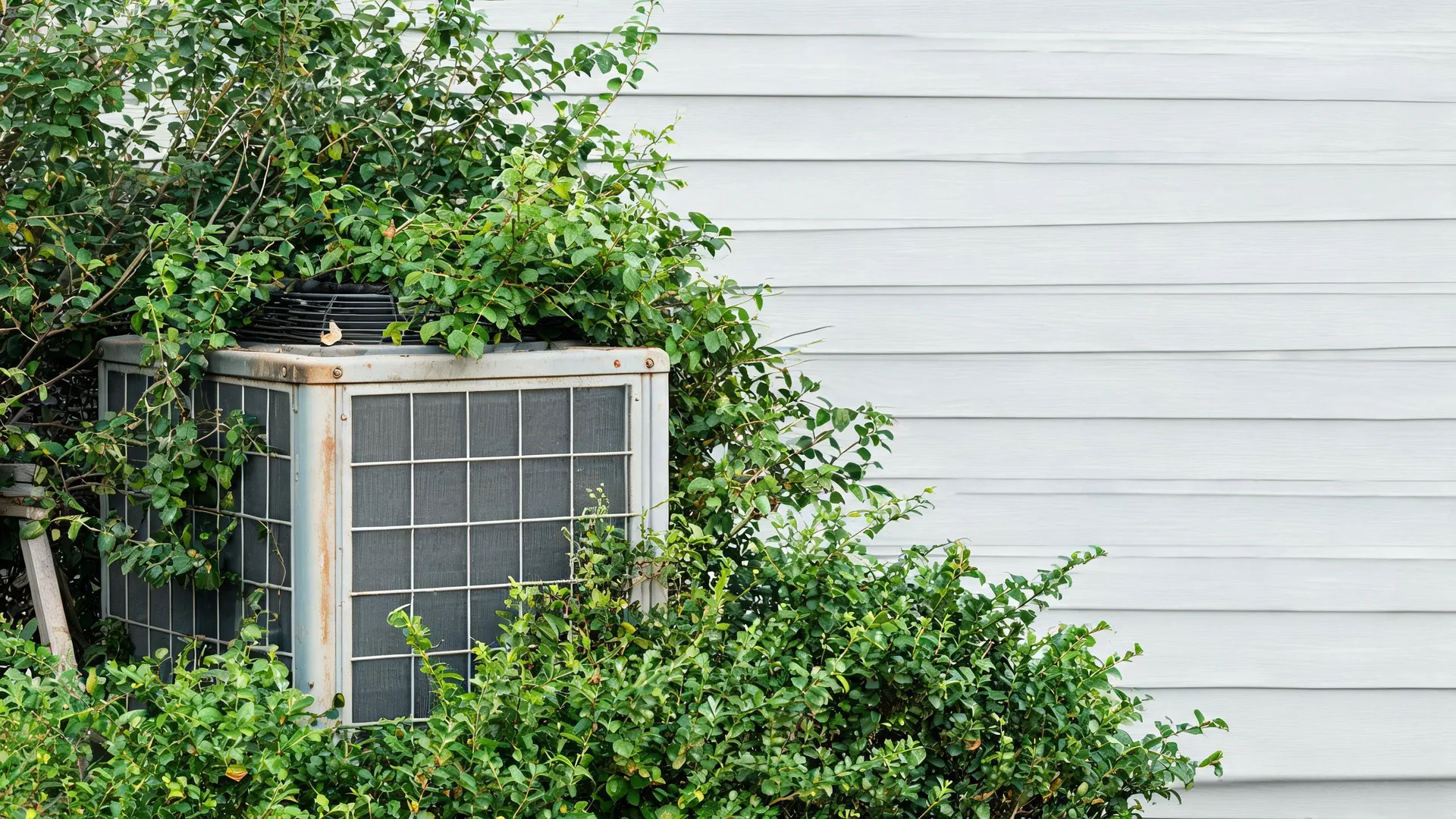
Look at the outdoor unit and clear away any leaves, dirt or ice blocking the coil or the fan. Check that the air filter inside isn't clogged, since a dirty filter starves the system of airflow and makes it work harder on both sides. Walk the vents and make sure none are closed or blocked by furniture. Check the thermostat batteries and make sure it's set to heat, not cool or fan only. These take a few minutes and rule out the simplest causes before anything else.
What to leave alone

Don't open the outdoor unit's panels or touch anything electrical inside it. Don't try to chip ice off the coil by hand, since that can bend the fins or damage the coil itself. If the unit is tripping a breaker, leave the breaker off and don't keep resetting it, since that usually means a part is drawing too much current and running it again can finish it off. A heat pump that smells burnt or makes a grinding or screeching noise needs a tech before it runs again, not after.

A heat pump in trouble usually tells on itself before it quits outright. Warm air that isn't quite warm, or air that feels cool coming out of the vents even though the system is running, often means it's stuck in defrost longer than it should be or leaning on backup heat that isn't keeping up. A unit that cycles on and off every few minutes instead of running a steady stretch is short cycling, and that's hard on the compressor every single time it restarts. Listen for it too. A clicking at startup that doesn't catch, a hum with no fan movement, or a new rattle or screech from the outdoor unit are all signs something mechanical is wearing out. Ice on the outdoor coil that doesn't clear on its own between cycles means the defrost cycle isn't doing its job. Any of these is worth a call before the unit tries to push through it.

A heat pump rarely needs a straight yes or no on repair versus replacement. Most of the time it needs someone to look at which part failed and what else is riding on that same circuit. A bad capacitor or a failed contactor is a clean fix on its own, regardless of the unit's age, because those parts wear out on a schedule that has nothing to do with the compressor's condition. The harder call comes when the compressor itself is the thing failing, since that's the most expensive part in the system and the one most tied to how many years the unit has left in it. A tech who's in there anyway can usually tell you if the rest of the system looks like it's aged alongside that part or if it's got more left to give. That's the real question, not whether a repair is possible. Almost anything on a heat pump can be fixed. Whether it's worth fixing is about what else is close behind it.