






View from under a wood-beamed patio roof across a gravel yard toward a stucco house wall and a concrete block boundary wall, with a large gnarled tree beyond.

Heat Pump Repair in Roy, NM

Tell us about the job

Takes about a minute. No obligation.

RepairHeat PumpHarding County, NM
Step 1 of 2

What ZIP code is the job in?

A heat pump that needs a new capacitor or a new contactor is worth fixing almost every time. Those are small parts that fail on their own, and replacing one brings the whole system back to normal. The harder call comes with the compressor or the reversing valve. Those sit at the heart of the system, and when one fails the labor to get at it costs nearly as much as the part itself. If your heat pump is old enough that one major part has already been replaced, and now a second one is going, that's usually a sign the whole unit is wearing out at the same time, not that you've had bad luck. A tech can tell you how much life is likely left in the rest of the system once they see what's actually failed.

7 months
October through April, your system heats
4 months
June through September, it cools
21°F
the average winter night it heats against
89°F
the average summer afternoon it cools against
Isometric grayscale illustration of a cutaway two-story house showing interior ductwork, an indoor air handler unit, and an outdoor condenser unit on a pad beside the building.
Your system heats October through April and cools June through September.

NOAA nClimDiv, 1991–2020 normals

Winter lows in Harding County average 21°F, not the deep cold that pushes a heat pump hard all winter.

A heat pump breaking down here is more likely worn or neglected than beat up by the climate, and wear and neglect are usually worth fixing.

Roy doesn't put extra strain on a heat pump. A breakdown here means a part failed, not that the climate wore it out.

Power costs 14.2 cents a kWh statewide
25 damaging wind events from 2015 to 2024
51 hail events from 2015 to 2024
Seven months of heat, then four of cooling, back to backHeat starts in October and cooling starts in June. The first weeks of each are when a weak part gives out.

So when a tech comes out, don't expect them to blame the weather. They'll check the capacitor, the contactor, the reversing valve, whatever's acting up, same as they would anywhere else. What they find is what tells you the real story, not the county you live in. If the unit's been maintained and this is the first real failure, fixing it is the right call. If it's been neglected for years, that's worth knowing too, before you spend the money.

Know what you're repairing before you pay for it

If your heat pump came with the house, ask the tech how much life it has left before you pay for the repair. That's especially worth asking if something else has already failed once before.

Find a contractor
A man in a cap, long-sleeved shirt and work pants walks up porch steps toward a dark gray paneled front door, carrying a canvas tool bag, with a potted shrub to the right.
A gray air-source heat pump mounted on a concrete pad next to a house with gray vinyl siding, surrounded by gravel and flanked by green shrubs and white hydrangea flowers.

Running both directions, all year, wears the parts that start and switch it

A heat pump runs hot and cold off the same system, all year, so it never really sits idle the way a furnace does in summer. That shows up first in the parts that handle starting and switching. A contactor that opens and closes every cycle will eventually pit and stick. A capacitor that gives the compressor and fans their starting kick loses strength over time, and you'll hear it as a hard start or see it as short cycling. Air that's not quite warm enough, or not quite cool enough, or a system that runs longer than it used to without catching up, points the same direction. Ice on the outdoor unit that the defrost cycle isn't clearing, especially on a mild day when frost shouldn't be forming heavy at all, is worth a call. So is a clicking that repeats instead of clicking once and running, or a hum with no fan movement. Those usually trace back to the same contactor or capacitor. None of this is wait and see. A system working harder to start or switch modes puts that strain on the compressor next, and that's the part you don't want to lose.

Check the thermostat and the breaker first

Make sure the thermostat is set to the mode you want and the setpoint is actually past room temperature. Then check the breaker panel for the outdoor unit and the air handler. A tripped breaker or a thermostat bumped into the wrong mode looks exactly like a failed system, and both are simple to rule out before anything else.
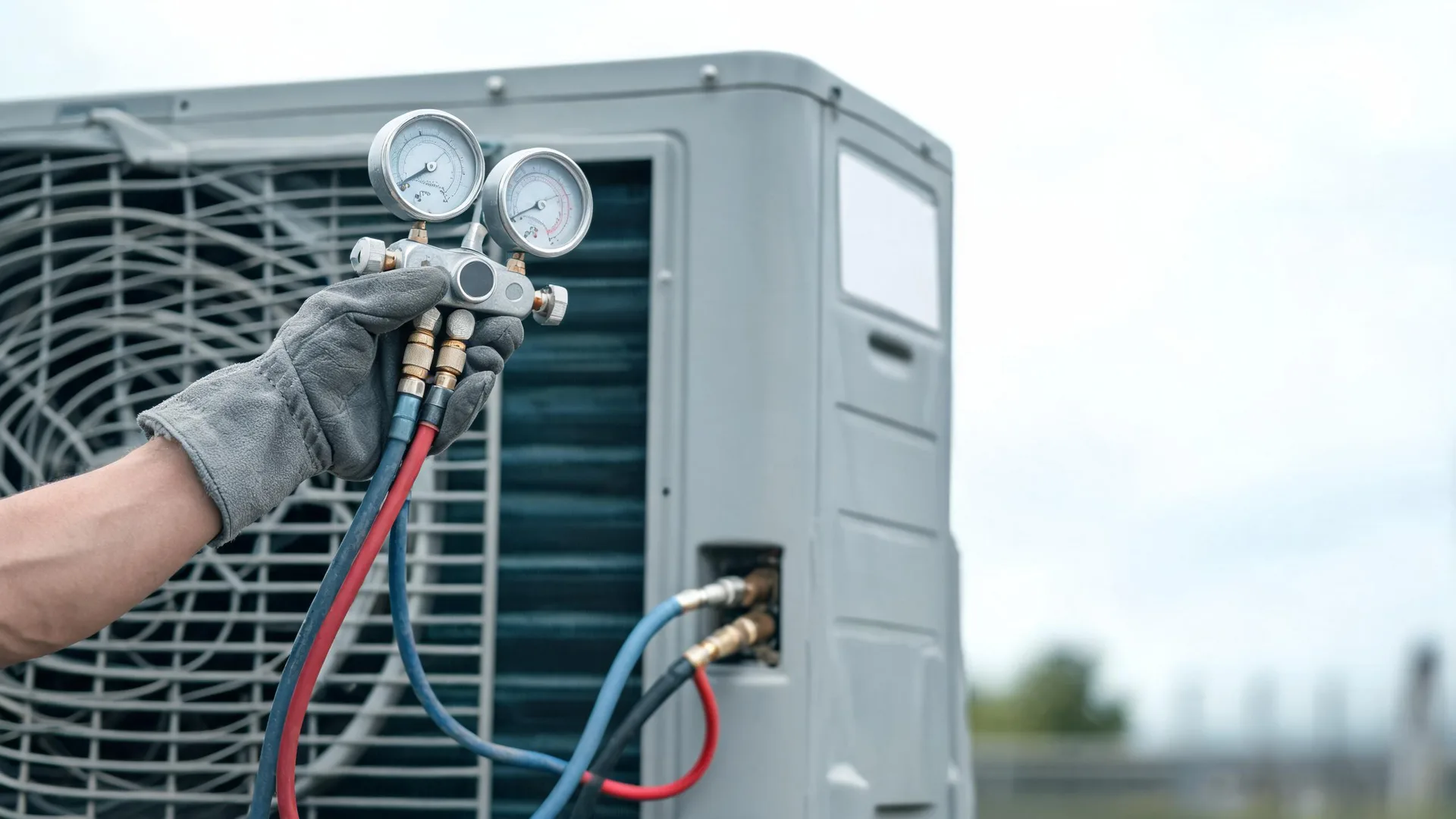
Look at the filter and the outdoor unit

Pull the air filter and hold it up to a light. If you can't see through it, swap it out. A clogged filter starves the system of airflow and can shut it down on its own safety switch. Then walk outside and look at the unit itself. Clear away leaves, grass clippings or anything stacked against it, and check that the fan on top isn't iced over on a day it shouldn't be. Airflow problems on either end show up as the same weak heating or cooling.

A heat pump that's struggling still has to run to keep the house comfortable, so a weak capacitor or a sticking contactor doesn't get a rest. Every cycle it has to fight through puts more strain on the compressor, and that's the part at the heart of the system. Ice that the defrost cycle can't clear adds to this, because the system keeps trying to push air through a blocked coil, drawing more current to do less work. A hard start that happens once in a while is one kind of problem. A hard start that happens every cycle for weeks wears the compressor windings a little more each time. The same goes for a reversing valve that's starting to stick. It may still switch most of the time, but each time it hesitates, the compressor works against pressure it shouldn't have to fight. None of that shows up on the thermostat as anything more than a system that seems a little slower than it used to be, which is exactly why it keeps running instead of getting looked at.

A diagnostic visit starts before any panel comes off. A tech will ask what the system is doing, when it started, and whether it happens in one mode or both. Then they check power and readings at the thermostat, the air handler, and the outdoor unit, because a complaint like weak heat can trace back to any of them. From there it's testing, not guessing. A capacitor gets checked against its rating, not just looked at. A contactor gets inspected for pitting and burn marks. Refrigerant pressures and temperatures get measured at the lines, because that's what tells a tech whether the charge is right or the reversing valve is doing its job. Only once the readings point somewhere does the real work start.