A flat-roofed adobe house lit from within at dusk, surrounded by saguaro cacti and desert landscaping with mountains in the background.

Heat Pump Repair in Gallup, NM

Tell us about the job

Takes about a minute. No obligation.

RepairHeat PumpMcKinley County, NM
Step 1 of 2

What ZIP code is the job in?

September is when a weak heat pump shows it

Heat here runs October through May, about eight months. When the system switches over in September and October, whatever part was already marginal gets asked to carry a full load for the first time since spring. That's usually when a breakdown shows up, not mid-winter.


Get it looked at before the load hits

A heat pump that struggled at the end of last season won't have fixed itself over the summer. If it was short cycling, running long, or blowing cool air in September, that same weak part is still in there. Having it checked before October puts the fix ahead of the demand instead of behind it.

8 months
October through May, your system heats
2 months
July through August, it cools
18°F
the average winter night it heats against
85°F
the average summer afternoon it cools against
Isometric cutaway illustration of a single-story house showing interior rooms with furniture, an attic duct network connected to a furnace or air handler, and an outdoor condenser unit linked by lines outside the wall.
Your system heats October through May and cools July through August.

NOAA nClimDiv, 1991–2020 normals

The reversing valve is what breaks down most often, since it switches position every time the system changes between heat and cool.

A valve stuck partway gives you a heat pump that runs but can't decide which job it's doing.

Gallup doesn't push this machine harder than normal. It just needs to work through winter.

64 damaging wind events from 2015 to 2024
44 winter storms from 2015 to 2024
Winter nights average 18°F
Gallup heat pumps fail the same way everywhereHalf the homes in McKinley County were built in 1985 or earlier, and a quarter are mobile homes. Neither one changes what's wrong with your heat pump.

Nothing about Gallup's winters asks more of a heat pump than what it's built for. The repair is usually a part failing on schedule, not the climate winning. A stuck reversing valve, a failing capacitor, a sensor giving bad readings, the same handful of things that go wrong on this machine anywhere it's installed. Electricity in New Mexico ran 14.20 cents per kilowatthour in 2024, so a heat pump running on a weak part isn't just colder air, it's that same system drawing power to do a job it can't finish. Finding which part failed and replacing it fixes the problem. It doesn't need to be a bigger search than that.

Get it looked at early

Problems tend to show up in the first weeks of the season, when the load hits a part that was already weak.

Find a contractor
A man in a dark long-sleeve shirt and tan work pants, seen from behind, carries a worn canvas tool bag up concrete steps toward a dark blue front door.
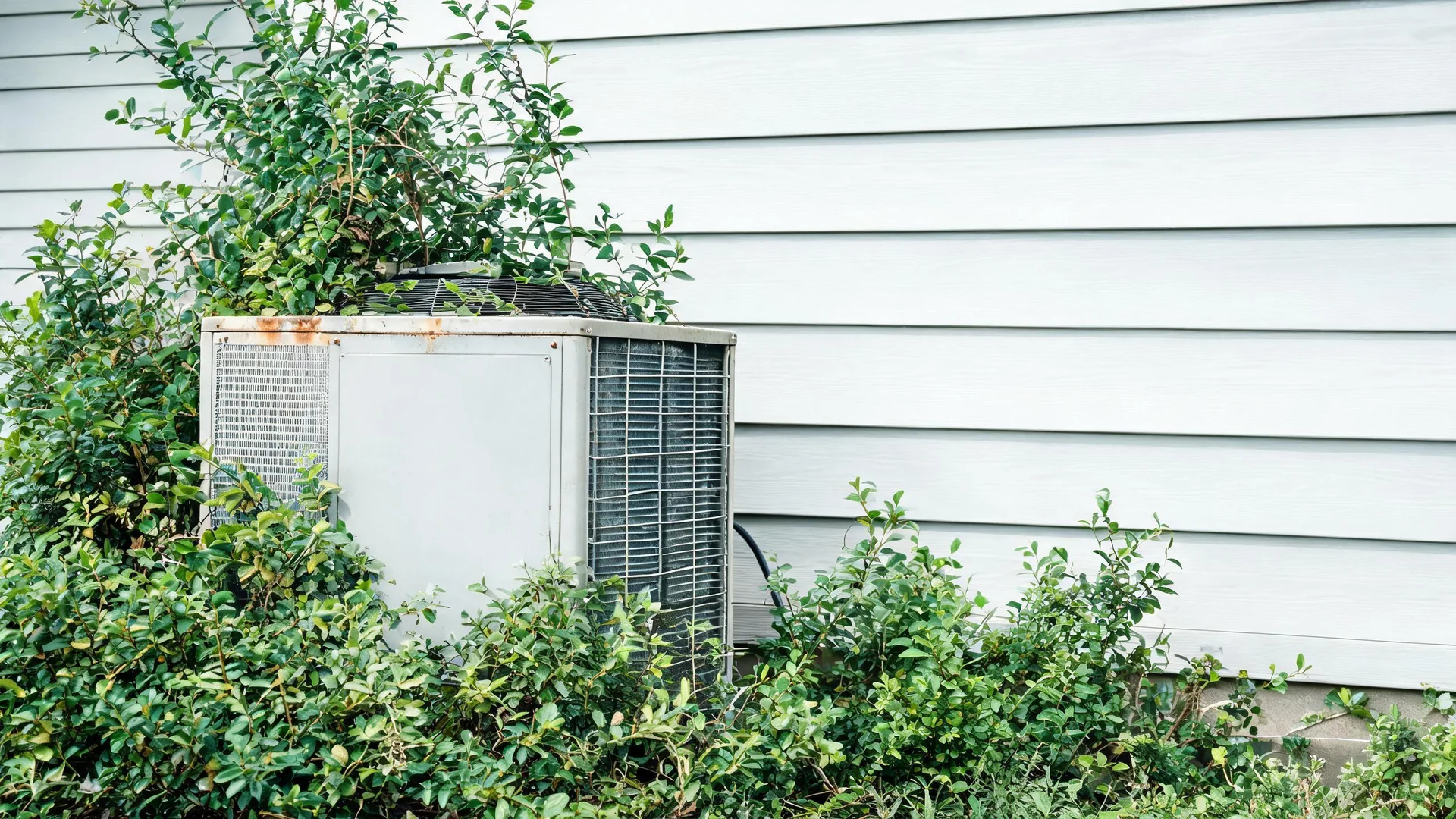
A gray heat pump outdoor unit mounted on a concrete pad next to a residential house with lap siding and stone accents.

Letting it run on a bad part wears down the next part too

A heat pump that's struggling doesn't fail all at once. It compensates. If the charge is low, the compressor runs longer to move the same amount of heat, and that raises its operating temperature a little more each cycle. If a contactor is pitted, it arcs a little more every time it closes, and that arcing wears it down faster than the cycle before. Nothing shuts the system off at this stage, so there's nothing telling you to stop. Run it another week on a weak capacitor and the compressor pulls harder on every start. That wear doesn't reset overnight, it carries into the next cycle and the one after. A system left running on a failing part is often harder to bring back than one that gets shut down and looked at the day it starts acting up.

It's blowing air that isn't warm

A heat pump in heating mode should feel warm at the vent, not room temperature. Air that feels barely warm or just like a draft usually means the reversing valve isn't fully switching, or the charge is low. The system keeps running, so it looks like it's working, but it's not making heat the way it should.

It won't stop running

A heat pump that never shuts off, or shuts off and starts again within a couple minutes, is short cycling. That points to a failing capacitor, a dirty sensor giving a false reading, or a compressor struggling to start. Each short cycle puts more wear on the parts around it, so the problem gets worse the longer it runs this way.

A few things are worth checking before you pick up the phone. Go outside and look at the outdoor unit. If it's caked in ice beyond the thin frost that's normal on a cold morning, that's worth noting, but don't chip at it or pour water on it. Check that nothing is blocking airflow around that unit, no leaves, no snow drift, nothing stacked against it. Inside, check your thermostat batteries if it uses them, and make sure it's actually set to heat and not sitting in some fan-only mode from warmer weather. Look at the filter. A filter clogged with dust chokes airflow across the indoor coil, and that alone can make a heat pump run weak or blow cool air. None of this fixes a bad reversing valve or a failing capacitor, but it rules out the simple stuff first, and it gives whoever comes out a clearer picture of what's actually wrong.

Once a part is actually failing, the question is whether it's worth fixing or whether the whole system is done. Most of the time it's worth fixing. A reversing valve, a capacitor, a sensor, these get replaced on their own without touching the rest of the system, and a heat pump that's otherwise sound goes back to working fine. What changes the math is a compressor failure. The compressor is the one part that isn't really a repair, it's close to the cost of the system itself, and a heat pump with a dead compressor is usually a heat pump that gets replaced. Age matters less than people think. A unit that's been maintained and is only now having its first real failure is a different case than one that keeps coming back with a new problem every season. Repeated failures on the same system mean something is wearing out faster than it should, and that's worth weighing against starting over with new equipment.