Adobe-style desert homes with warm exterior lighting, saguaro cacti, and desert landscaping along a curved street at dusk, with mountains in the background.

Heat Pump Repair in Deming, NM

Tell us about the job

Takes about a minute. No obligation.

RepairHeat PumpLuna County, NM
Step 1 of 2

What ZIP code is the job in?

What the repair history tells you

A heat pump that's needed the compressor or the reversing valve replaced once is more likely to need major work again. Those parts fail because of strain the rest of the system puts on them, and if that strain is still there, the next part in line wears the same way. A unit that's only needed a capacitor or a thermostat swap is a different story. Those are wear items on any system and don't point to a deeper problem.


What a contractor weighs before recommending either

A contractor looks at which part failed, how old the outdoor unit is, and whether the refrigerant it uses is still easy to get. A cracked heat exchanger or a failed compressor on an older unit usually points to replacement, since the labor to open the system back up costs nearly as much as a new one. A bad capacitor, contactor, or fan motor is a straightforward repair on a system of any age.

6 months
November through April, your system heats
5 months
May through September, it cools
29°F
the average winter night it heats against
94°F
the average summer afternoon it cools against
Isometric line illustration of a cutaway house showing interior rooms, an air handler with ductwork in the attic space, and an outdoor condenser unit beside the exterior wall.
Your system heats November through April and cools May through September.

NOAA nClimDiv, 1991–2020 normals

The reversing valve is what breaks most often, since it switches direction every time the system changes between heating and cooling.

A stuck reversing valve can leave the system blowing cold air in heating mode or no air at all, and that's a repair worth calling in fast.

Half the heat pumps in Deming are as old as the house

Half the homes here were built by 1980
Power costs 14.2 cents a kWh statewide
Climate zone 3B

Half the houses in Luna County were built in 1980 or earlier, which puts a lot of heat pumps here well past the age where repair makes sense. If your outdoor unit came with the house and nobody's replaced it since, ask the contractor straight out how many years it's got left before you pay for anything major. A compressor or reversing valve job on a unit that old is money you may not get back. Get the age and the repair history in front of them before they quote you anything.

Ask how much life it has left

If your system came with an older house, it may be near the end of its life. Ask how much life it has left before paying for a big repair.

Find a contractor
A man in a dark shirt and tan pants carries a canvas tool bag up stone steps toward a dark blue front door, with a potted shrub beside the entry.
A gray air-source heat pump mounted on a concrete pad next to a house with gray vinyl siding, surrounded by gravel and flanked by green shrubs and white hydrangea flowers.

It runs every day of the year, not just one season

A heat pump runs in both directions all year, so it never really gets a season off the way a furnace or an AC does. That constant switching between heating and cooling puts steady wear on the reversing valve and keeps the compressor cycling on nearly every day. Watch for ice building up on the outdoor unit when it shouldn't be there, air coming out lukewarm instead of hot, or the system running long stretches without shutting off. A unit that short cycles, turning on and off in quick bursts, is working harder than it should and wearing parts down faster. Any of these are worth a call before the part that's struggling takes another one down with it.

November and May are when it shows up

Heat pumps here switch over to heating in November and back to cooling in May. A part that was already weak usually waits until that first cold morning or that first hot week to quit, because that's when the system finally has to run full out.

October and April are when to get it looked at

If your heat pump struggled last season, the same weak part is still in there. Getting it checked in October or April, before the switch, means finding that part before the load hits it again, not after.

A heat pump that's struggling still has to run, and running makes most problems worse, not better. A weak capacitor forces the compressor to draw more current to start, and that extra draw is what finally kills it. A low refrigerant charge makes the compressor work harder to move heat, and it runs hotter than it was built to. Ice on the outdoor coil blocks airflow, so the system pulls in less heat each cycle and runs longer to make up for it, which only builds more ice. None of these fix themselves by waiting. The part under strain stays under strain until something gives, and usually what gives is the compressor itself.

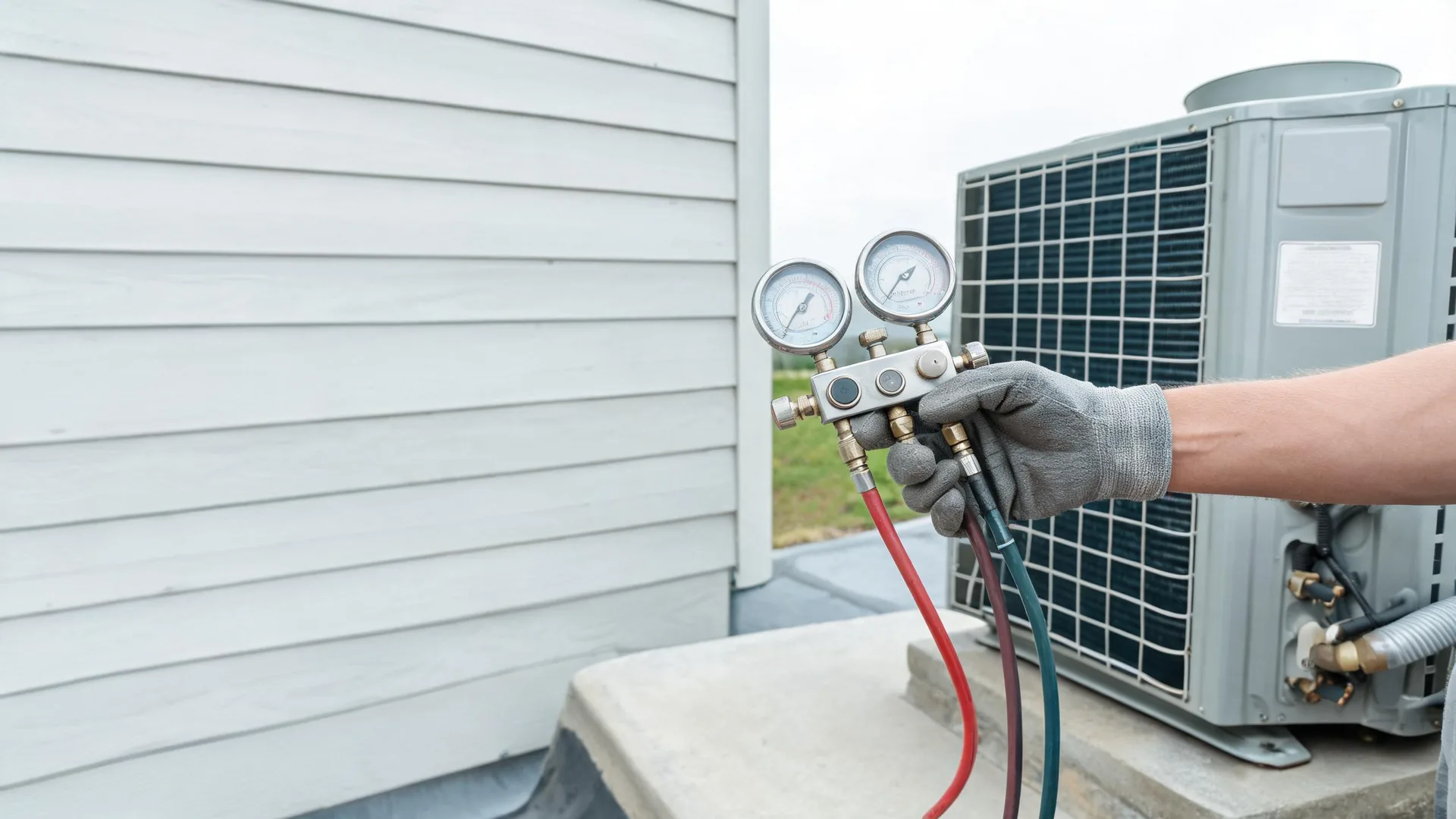
A diagnostic visit starts outside, at the unit itself. A contractor checks the refrigerant pressure, the amp draw on the compressor, and the temperature of the air coming off the coil, since those point to most problems before a panel ever comes off. Inside, they'll check the air handler for a dirty filter or a frozen coil, because either one can mimic a failing part that's actually fine. They'll also run the system through a full cycle, switching it between heating and cooling, to see whether the reversing valve actually shifts when it's told to. Most of what's wrong shows up in that sequence. What takes longer is tracing why a part failed in the first place, since replacing it without knowing that just sets up the next one to go the same way.