A low-profile adobe house with glowing windows and landscape lighting, surrounded by desert rocks, shrubs, and a saguaro cactus at dusk.

Furnace Repair in Moriarty, NM

Tell us about the job

Takes about a minute. No obligation.

RepairFurnace or heatingTorrance County, NM
Step 1 of 2

What ZIP code is the job in?

Short cycling wears out parts fast

A furnace that fires up, runs for a couple minutes, then shuts off before the house warms up is short cycling. That's often a dirty flame sensor failing to prove the flame, a cracked heat exchanger tripping a safety switch, or a clogged filter choking airflow. Each start-stop cycle stresses the igniter and blower motor, so the longer this goes on, the more parts it tends to take out with it.


A burning or metallic smell is not normal

Dust burning off at the start of the season clears out fast. A smell that lingers, or one that's sharp and metallic, points to something rubbing where it shouldn't or wiring insulation heating up. That's worth shutting the furnace off and getting someone to look at it rather than running it another night.

8 months
October through May, your furnace is on duty
21°F
the average winter night it heats against
69 winter storms
in ten years, the nights a failure hurts most
Isometric line illustration of a cutaway single-story house showing interior rooms with furniture, ceiling ductwork, a chimney flue, and a furnace unit outside the exterior wall.
Your furnace works hardest from November through March.

NOAA nClimDiv, 1991–2020 normals

Furnaces in Torrance County start running in October and go through May.

The first cold snap after months idle is when a weak igniter or a cracked exchanger finally gives out.

Torrance County weather is not unusual, and most furnace trouble here isn't either

340 severe weather events from 2015 to 2024
13% of homes statewide lost power a day or more in 2024
220 damaging wind events from 2015 to 2024

A furnace that's struggling doesn't fail all at once. A cracked heat exchanger starts small, and the safety switch shuts the burner down before it gets dangerous. Keep resetting it and running the furnace anyway, and the crack spreads under the heat until the switch can't catch it in time. A failing igniter is the same story. It glows weaker each cycle, takes longer to light the gas, and one day it won't light it at all, usually on the coldest morning of the week. Even something as simple as a dirty flame sensor gets worse the longer it runs dirty, because the soot builds on it a little more each cycle until it stops reading a flame that's actually there. None of these fix themselves by running longer. They just get further along.

Eight months of winter work will wear a furnace down. Find out what gave first.

Your furnace runs eight months here, October through May, with overnight lows averaging 21°F through the worst of winter. That's a long stretch of hard running, and it's usually what's behind trouble like this. A tech can tell you whether it's a worn part or something further along, and fix the one that's actually wrong.

Find a contractor
A man in a cap, dark shirt and tan pants, seen from behind carrying a canvas bag, climbs wooden porch steps toward a blue front door beside a potted evergreen.
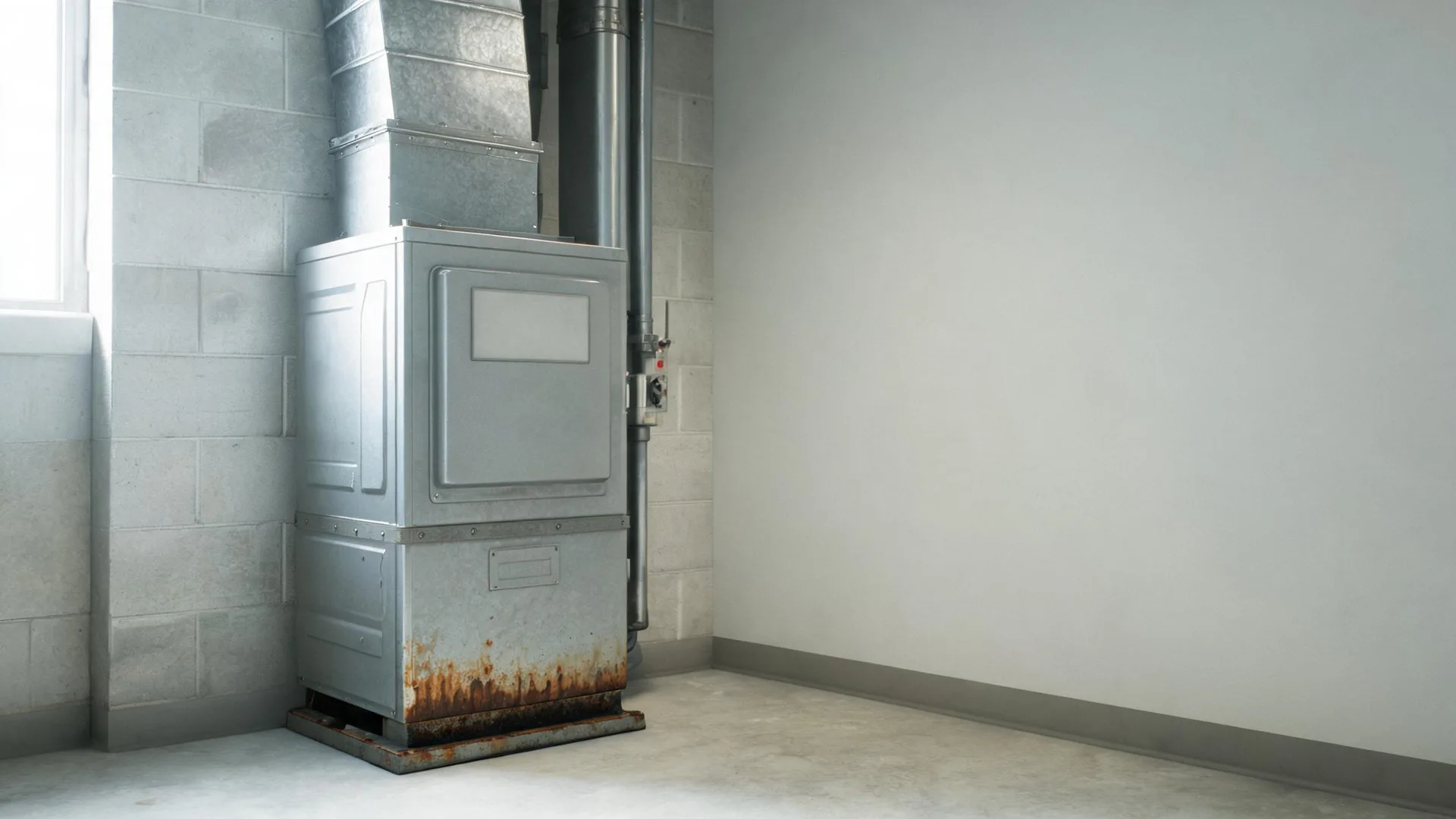
A gray residential gas furnace installed in an unfinished basement, surrounded by ductwork, a metal flue pipe, and a gas supply line.

What you can check before you call

Pull the filter and hold it up to a light. If you can't see light through it, swap it, because a clogged filter chokes airflow and can trip the limit switch on its own. Check the thermostat batteries if it's got a blank or dim screen. Look at the vent pipe outside where it exits the house and clear away anything blocking it, snow, a nest, leaves. Flip the breaker for the furnace off and back on, since a weak connection there can look exactly like a dead furnace. If you've got a standing pilot, see whether it's lit before you assume the worst. What you shouldn't do is keep resetting the switch on the furnace itself over and over to force it to run. That switch is tripping for a reason, and running it anyway is how a small problem turns into a cracked heat exchanger or a burned-out blower motor.

Most failures start with airflow

A furnace needs air moving across the heat exchanger to keep it from overheating. A clogged filter, a blocked return, or a blower wheel caked with dust all choke that airflow the same way. Restrict it long enough and the limit switch starts tripping, or the heat exchanger itself takes the stress and cracks.

The parts that fail are the ones that cycle

The igniter heats up and cools down every single cycle, and that's what wears it out, not age on its own. Flame sensors and pilot assemblies fail the same way, a little more carbon or corrosion each time the burner fires. A furnace that's run through a lot of cycles is closer to needing one of these replaced than a furnace that hasn't.

An unfinished basement featuring concrete block walls, exposed floor joists, and a metal forced-air furnace with ductwork near a central pillar.

A new furnace would cut about $70 a year off heating for a typical Torrance County home.

  • A new high-efficiency furnace$320 a year
  • An older furnace$390 a year

Estimates for a typical Torrance County home, compared with an older unit built to the previous federal minimum, from EIA household energy data, New Mexico fuel prices and NOAA climate normals. Your home will differ.

Repair makes sense when one part has failed and the heat exchanger is sound.

Replacement makes sense when the heat exchanger is cracked or the furnace keeps needing parts.

A furnace is worth fixing when the failure is one part acting up and the rest of the system is sound. An igniter, a flame sensor, a pressure switch, these get replaced on their own all the time, and the furnace goes back to running fine. A cracked heat exchanger is different. That's the part that separates the flame from the air moving through your house, and once it's cracked it doesn't get welded back, it gets replaced, and on most furnaces that means replacing the whole unit around it. Age matters less than what's actually failed. A furnace with one bad part and an otherwise clean burner and a sound exchanger has a lot of life left in it. A furnace where the tech finds rust inside the cabinet, a scorched wire, or more than one part failing at once is telling you it's further along than a single repair fixes.