




How long a furnace lasts in Rio Rancho, NM

Get matched with a pro who works on furnaces in Sandoval County.

Get my match

A gas furnace in Rio Rancho runs about 15 to 20 years before it needs to be replaced rather than repaired. What wears it out is the work it does every winter here. Winters in Sandoval County are hard, so the burner and heat exchanger cycle on and off for months at a stretch, and that steady heat and cooling is what ages the metal and the ignition parts. A furnace that gets serviced each fall tends to land at the far end of that range. One that doesn't often fails earlier, usually with the heat exchanger cracking or the igniter going out for good. If yours is 15 years old or more and you're seeing a repair bill, it's worth asking whether that money is better spent on a new unit. Past 20 years, most furnaces are running on borrowed time, and a hard freeze is the wrong moment to find out.

Why does a furnace in Rio Rancho work this hard every year?

  • Winter nights average 19°F

    Winter nights average 19°F. That's cold enough that your furnace runs full cycles for hours, not short bursts, and the burner and heat exchanger take the wear.

  • Heat runs October through May

    Heat runs October through May. Eight months of the year is more than half, so the furnace gets little rest between seasons to cool down and recover.

  • 75% of homes heat with gas

    75% of homes heat with gas. That's most of Sandoval County, which is why a local contractor sees the same furnace models and failures season after season.

NOAA nClimDiv 1991-2020 · ACS 2020-2024

How a Furnace Actually Wears Out

  • The heat exchanger cracks or weakens first, usually from repeated expansion and contraction over many winters.
  • A cracked heat exchanger is a safety issue, not just a repair, because it can let combustion gases into the duct air.
  • The burner assembly and igniter wear from the number of cycles they complete, not just from age on the calendar.
  • Dust and grit pulled through the system add friction to the blower motor bearings over years of run time.
  • A furnace that short-cycles, turning on and off in quick bursts, wears its components faster than one that runs long steady cycles.
  • Once the heat exchanger goes, replacement is almost always the right call because that part isn't meant to be swapped on its own.

The heat exchanger is the part that decides how long your furnace lasts. It's the metal chamber that separates the flame from the air blowing into your ducts, and every time the burner fires, it heats up and expands, then cools and contracts again when the cycle ends. Do that for enough winters in Sandoval County, where the furnace is running long steady cycles for hours at a time, and the metal fatigues. Small cracks start. Once that happens, it's not a part you patch. A cracked heat exchanger can let combustion gases mix into the air headed through your ducts, so a contractor who finds one will tell you to replace the furnace rather than repair it.

Other parts wear out on their own schedule, tied to how often the furnace cycles rather than the date it was installed. The burner assembly and igniter take a hit every time they fire, so a furnace that cycles on and off in short bursts all winter wears faster than one that runs longer, steadier cycles to hold the same temperature. The blower motor has its own failure point. It pulls air through the system constantly, and the dust and grit that ride along with that air add friction to the bearings a little at a time, year after year. None of this shows up as one dramatic failure. It shows up as a furnace that needs more repairs each winter until the heat exchanger itself finally gives out, and at that point replacement is the only real option left.

An older woman with gray hair in a cream knit sweater sits under a blanket on a sofa by a window, looking outside toward yellow-leaved trees, with a lamp, shelves and an armchair in the room behind her.
A gray-haired woman in a chunky knit sweater sits in an armchair with a blanket, looking out a window at yellow autumn foliage, with bookshelves and a potted plant behind her.
A gray-haired woman in a navy sweater sits in an armchair with a knit blanket beside a window, looking out at yellow autumn foliage, with a dining table and houseplant in the room behind her.
A gray-haired woman in a gray cowl-neck sweater sits in an armchair with a blanket, looking out a dark-framed window toward yellow autumn trees.
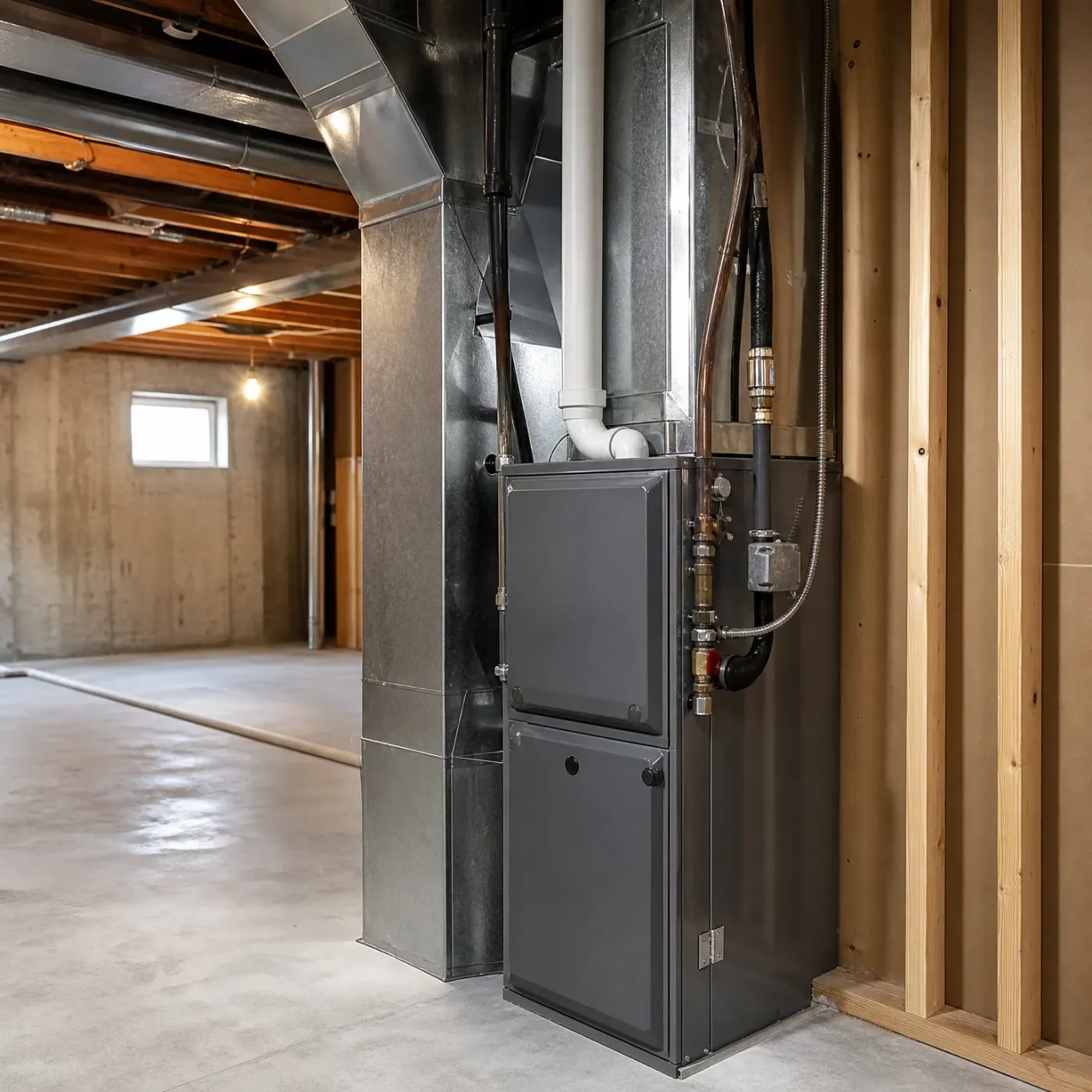
A gray furnace with copper and flexible piping stands against a wood-framed wall in an unfinished basement, connected to galvanized sheet-metal ductwork and PVC venting, with a concrete floor and exposed joists.

Get matched with a furnace pro in Sandoval County

The pro who gets in touch is licensed in New Mexico and works in Sandoval County.

Your request goes to a Sandoval County pro who takes furnace jobs.

Request a pro

It costs nothing to send, and you don't have to hire anyone.

Is your furnace starting to show its age?

You'll likely hear it before you see it. A furnace on its way out runs longer cycles and still leaves some rooms cooler than others. The burner may click on and off more than it used to, or you'll notice a burnt dust smell the first few times it fires up for the season. Some homeowners hear a boom at startup, which means the burner isn't igniting cleanly. Yellow flame instead of blue is worth a look too. None of this means tonight is an emergency, but a heat exchanger that's cracked or weakening can let combustion gases reach the air moving through your ducts, and that's not something to leave for next winter to answer.

A gray high-efficiency furnace in a basement with PVC vent pipes, sheet-metal ductwork, copper and insulated pipes, a water heater at left, and an unfinished wood-stud wall at right.

A furnace running the way it should

This is what a sound setup looks like: a furnace venting through PVC pipe, sitting clean on its pad with the ductwork sealed up tight. It fires, heats the house evenly, and shuts off. Nothing to notice, which is the point.


An older beige furnace with louvered front panels stands on a concrete basement floor beside galvanized ductwork, metal and plastic pipes, exposed wood framing, and a cylindrical water heater at right.

A furnace on borrowed time

Galvanized flue pipe like this points to an older unit, one that's likely put in many winters already. Exposed framing and aging pipe nearby don't help its case. If yours looks like this, a contractor can tell you how much life is actually left in it.

Repair the Furnace or Replace It

Repair it

  • Repair makes sense if the heat exchanger is still sound and the failure is a part like the igniter, the flame sensor, or the inducer motor.
  • A furnace under 15 years old that's had one failure is usually still a repair, not a replacement.
  • Parts for a furnace already installed are often still available, so the fix is quick and doesn't touch the ductwork or venting.
  • If the repair is the first one this furnace has needed, it's likely an isolated failure rather than the start of a pattern.
  • A repair buys time without committing you to a new system before you've had a chance to plan for one.

Replace it

  • A cracked heat exchanger means replacement, since that part isn't something a contractor patches and trusts again.
  • Past 15 to 20 years, a furnace in Sandoval County has likely logged enough winters that more than one part is near failing at once.
  • If you're repairing the same furnace more than once in a couple of years, each new fix is money on a system still heading toward failure.
  • A new furnace installed now means you're not troubleshooting a breakdown on the coldest night of the year.
  • Replacing before the old unit fails completely gives you time to size the new system to your house instead of grabbing whatever fits fast.
A gray high-efficiency furnace with two access panels stands in a bare basement corner, connected to sheet-metal ductwork, white PVC vent pipes, and flexible gas and electrical lines.

What 19°F nights do to steel

A heat exchanger is steel, and steel expands when the burner fires and contracts when it shuts off. On a 19°F night your furnace holds a long cycle, so that metal heats and cools many times before morning. Do that every winter for 15 years and the metal gets brittle where it flexes most. That's where the cracks start, not at the edges, but along the seams that move the most each cycle.

A gas furnace with metal ductwork, copper and yellow gas piping stands against a wall in an empty room with a bare concrete floor.

Why the fuel line matters less

Gas furnaces fail at the parts that see heat and motion, not at the gas line itself. The igniter sits in the direct path of the flame every time the burner lights, which in Rio Rancho is most mornings from October through May. The inducer motor runs any time the burner does, pulling exhaust out through the vent. Those two parts see more cycles in one Sandoval County winter than a furnace in a milder state sees in two.

A woman in a cream sweater and jeans stands in the open doorway of a white stucco house, holding the dark door, while a man in a dark quilted jacket seen from behind walks toward the entry past potted plants.

Fifteen to twenty years, if it's cared for

A furnace in Rio Rancho earns its keep over 15 to 20 winters, give or take, depending on how well it was installed and how it's been maintained since. Past that point you're watching for the heat exchanger, not waiting on a surprise. The signs show up first: longer cycles, uneven rooms, a burner that clicks more than it used to.

Once you know which side of that line your furnace is on, the next question is who handles it. A new installation in Sandoval County has to account for 19°F nights and a long heating season, and that's work best done by someone who installs furnaces in this area every winter and knows what this climate asks of them. You'll be matched with one licensed local contractor for your situation, not a handful of companies bidding for your number.

A living room corner with a beige sofa and cushion, a round wooden coffee table holding a pale ceramic vase of eucalyptus stems and a wooden bowl, and a curtained window with a potted plant above a latticed radiator cover in the background.
A woman in a cream knit sweater sits in an armchair with her eyes closed near a window showing yellow autumn foliage, with a mug on a round wooden side table beside her.
A gray-haired man with a beard in a blue button-placket shirt reclines on a couch with his eyes closed, beside a sunlit window with a green plant.

Furnace Installation

Find a furnace installation pro in Sandoval County

A licensed pro who works in Sandoval County gets your request.

A black-framed smartphone standing upright against a plain white background, its screen filled with solid green.
New system or replacementFurnace or heatingSandoval County, NM
Step 1 of 2

What ZIP code is the job in?





