






Three adobe-style desert homes with warm landscape lighting, surrounded by saguaro cacti and desert vegetation under a deep blue dusk sky.

Heat Pump Repair in Truth or Consequences, NM

Tell us about the job

Takes about a minute. No obligation.

RepairHeat PumpSierra County, NM
Step 1 of 2

What ZIP code is the job in?

A heat pump works year round, so it wears differently than a furnace that rests all summer or an AC that rests all winter. That matters when you're deciding whether to fix it or replace it. If the compressor is failing, that's usually the end of the line, since it's the most expensive part and the one the rest of the system depends on. If it's a capacitor, a contactor, or a fan motor, those are normal wear parts and replacing them is routine. Age matters too, but not by itself. A unit that's been short cycling or losing refrigerant for a while has usually been working harder than it should, and that catches up with other parts. Ask the technician which part failed and whether it's original to the unit before you decide anything.

7 months
October through April, your system heats
4 months
June through September, it cools
27°F
the average winter night it heats against
90°F
the average summer afternoon it cools against
Isometric line illustration of a cutaway single-story building showing interior rooms, ceiling ductwork, an indoor air handler, and an outdoor condenser unit connected by refrigerant lines.
Your system heats October through April and cools June through September.

NOAA nClimDiv, 1991–2020 normals

Winter nights here average 27°F, not the deep cold that pushes a heat pump to its limit.

A heat pump that isn't straining against the cold all winter usually has more life left in it, worth fixing rather than replacing.

Half the homes here were built by 1983, and age isn't what breaks a heat pump

Half the homes here were built by 1983
32 damaging wind events from 2015 to 2024
11 hail events from 2015 to 2024

So when a tech opens up your unit, ask what it was doing before it failed. A mild winter here means less strain on the compressor over the years, which is part of why a failed part is usually worth replacing rather than a sign to start over. If the unit's been running fine for years and one part gave out, that's a straightforward fix. Ask whether the failed part is original to the unit. That tells you more about what's ahead than the age of the house it's attached to.

It's usually worth repairing

It has an easier job here than in most places, so your heat pump is often in decent shape. Repair is usually worth it.

Find a contractor
A man in a dark shirt and khaki pants, seen from behind, carries a worn leather bag as he climbs wooden porch steps toward a dark front door, with a potted shrub beside the entry.
A dark gray heat pump unit mounted on a concrete pad next to a house with gray siding and a stone veneer wall.

What to check before you call

Before anyone comes out, check the thermostat first. Make sure it's set to heat, not cool, and that the setpoint is actually above room temperature. Go outside and look at the outdoor unit. Some frost on it is normal, heat pumps defrost themselves on a cycle, but a unit fully caked in ice that never clears needs a tech. Clear away anything blocking airflow around it, leaves, dirt, a cover left on by mistake. Inside, pull the filter and hold it up to a light. If you can't see light through it, swap it or clean it, since a clogged filter starves the system of airflow and makes everything downstream work harder. Check the breaker box for anything tripped. None of this fixes a bad compressor or a refrigerant leak, but it rules out the simple stuff before you pay someone to find it.

What you'll notice first

Air still comes out of the vents but it doesn't feel warm, just room temperature or close to it. That's usually the system stuck in a defrost cycle it can't get out of, or the reversing valve not switching over the way it should. A heat pump that runs constantly without the house ever getting comfortable is working but not keeping up, which points to low refrigerant or a failing compressor rather than something simple.
Noises and smells mean something specific

A hard clunk when the system starts or stops is usually the reversing valve shifting. A grinding or squealing sound points to the fan motor bearings going bad. A burning smell when the heat kicks on can mean dust burning off a dirty component, but if it lingers past the first few minutes, shut the system off and have it looked at rather than waiting to see if it clears on its own.

Most heat pump failures trace back to a handful of parts. The capacitor gives the compressor and fan motor the jolt they need to start, and it weakens over time until the motor can't get going at all. Contactors wear from the arcing that happens every time they open and close, so eventually they stick or stop making contact. The reversing valve, which is what lets the unit switch between heating and cooling, can fail stuck in one position after years of shifting back and forth. Refrigerant doesn't get used up, so if the charge is low, something is leaking, and that leak needs finding before the system gets recharged. Outdoor fan motors sit exposed to weather year round, and their bearings eventually wear out from the moisture and debris they're built to tolerate but not forever.

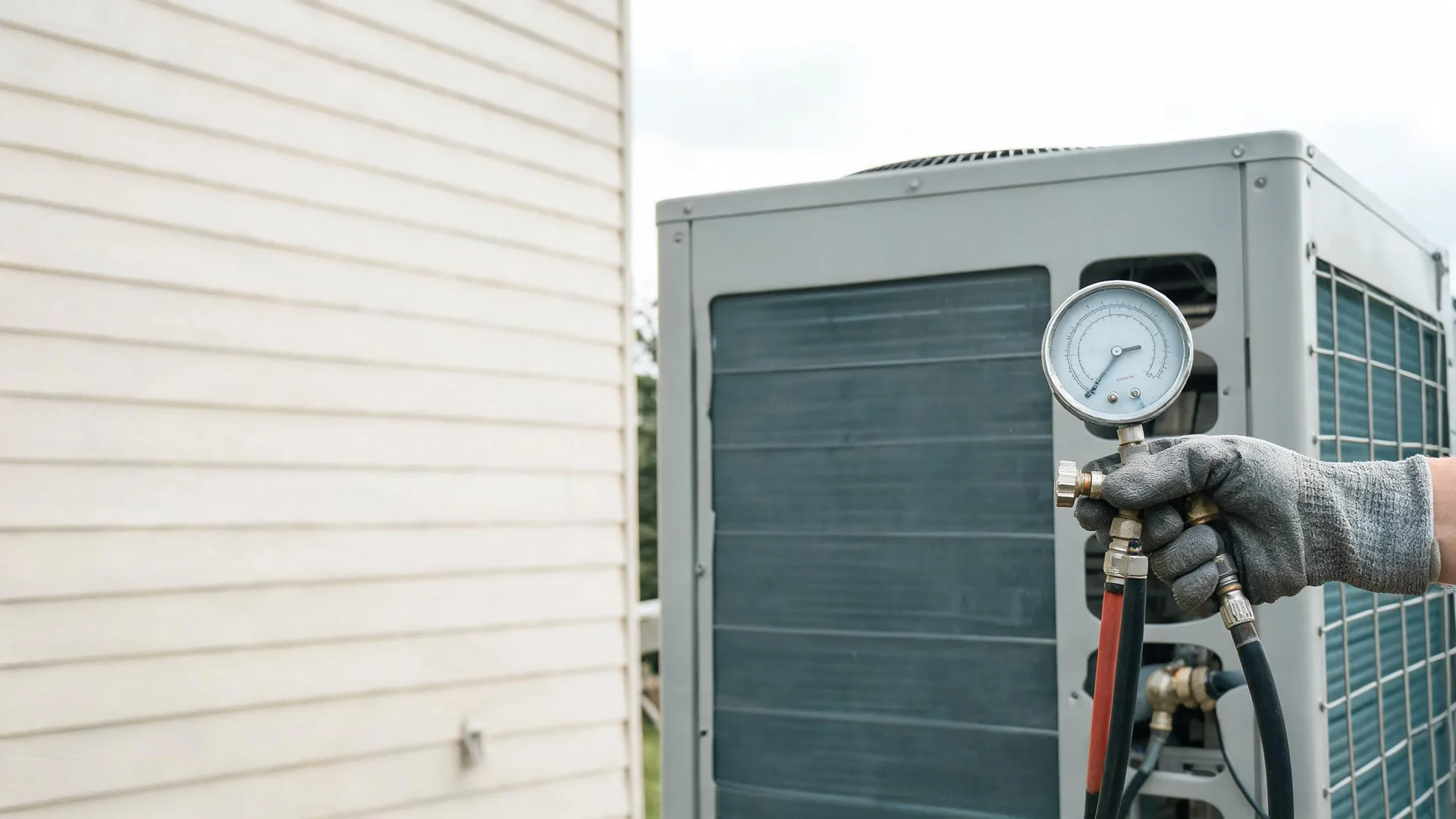
A diagnostic starts outside at the unit, not inside at the thermostat. The tech checks refrigerant pressure with gauges, since that number tells them more than the symptoms alone do. They'll check the reversing valve by feel. Both refrigerant lines should change temperature when the system switches between heating and cooling, and if one doesn't, that valve is suspect. Electrical testing comes next, checking the capacitor, the contactor, and the windings in the compressor and fan motor against what each part should read. Airflow gets checked too, the static pressure across the coil and filter, because a system can have good refrigerant and good electrical and still underperform if air isn't moving through it right. The tech should be able to tell you which of these pointed to the failure, not just that something failed.