A flat-roofed adobe house lit from within at dusk, surrounded by saguaro cacti and desert landscaping with mountains in the background.

Heat Pump Repair in Santa Fe, NM

Tell us about the job

Takes about a minute. No obligation.

RepairHeat PumpSanta Fe County, NM
Step 1 of 2

What ZIP code is the job in?

Winter nights are the real test

Overnight lows average 20°F through December, January and February. A heat pump works hardest at those temperatures. If one is struggling now, the likely cause is low refrigerant charge, a failing defrost control or a worn part, not the cold itself.


The cause is usually mechanical

Hail, wind and winter storms can nick an outdoor coil or knock a connection loose. But most heat pump problems in Santa Fe trace back to normal wear. A bad capacitor. A stuck reversing valve. A dirty coil. A technician checks the unit itself before looking anywhere else.

8 months
October through May, your system heats
2 months
July through August, it cools
20°F
the average winter night it heats against
84°F
the average summer afternoon it cools against
Isometric cutaway illustration of a small house showing interior rooms with furniture, an indoor air handler with ductwork, and lines running to an outdoor condenser unit beside the building.
Your system heats October through May and cools July through August.

NOAA nClimDiv, 1991–2020 normals

Heat here starts in October, right after September cools off.

A heat pump that limped through summer with a weak part usually fails in the first cold snap, not before.

Wind and hail here are unremarkable. A worn part is still the likely answer

Power costs 14.2 cents a kWh statewide
187 damaging wind events from 2015 to 2024
62 hail events from 2015 to 2024
Half the homes here were built in 1989 or laterA newer heat pump is usually worth fixing.

A heat pump that runs but won't heat well is usually worth fixing. A reversing valve, a defrost control board, a capacitor, each is a single part with a single job, and swapping it out brings the whole system back to normal. The compressor changes that math. It sits at the center of the system, and when it fails, the cost of that part alone starts to compete with a new unit, one that will run more efficiently besides. Age matters too, though not by itself. A unit with one failed part and a clean history is a different case from one that's needed a repair call every season. A technician can tell you which kind of failure this is before you decide anything.

A newer system is worth a repair call before anything else

If your heat pump came with the house, there's a good chance it's one of the newer ones. A single failed part on a system like that is worth fixing, and a technician can tell you in one visit whether that's what you're looking at.

Find a contractor
A man seen from behind in a dark long-sleeve shirt, olive work pants and brown boots climbs porch steps toward a gray front door, carrying a waxed canvas tool bag with tools in its outer pockets, beside a potted shrub.
A dark gray heat pump unit mounted on a concrete pad next to a house with gray siding and a stone veneer wall.

Running both directions wears different parts

A heat pump runs both directions, all year, and that doubles the parts that can wear out. The reversing valve is the one unique to this machine. It slides back and forth every time the system switches between heat and cool, and over years that sliding wears the seal until the valve starts bleeding refrigerant past itself instead of directing it. The defrost control is the other weak point. It has to sense coil temperature and cycle the system into defrost and back, and when that sensor or board drifts out of spec, the outdoor coil ices over and stops pulling in heat. Capacitors fail on a simpler schedule. Heat pumps cycle on and off far more than a furnace does, and every start puts a jolt through the capacitor that kicks the compressor and fan motors over. That adds up faster in a system that's always switching modes to keep up with the temperature outside.

What you can check safely

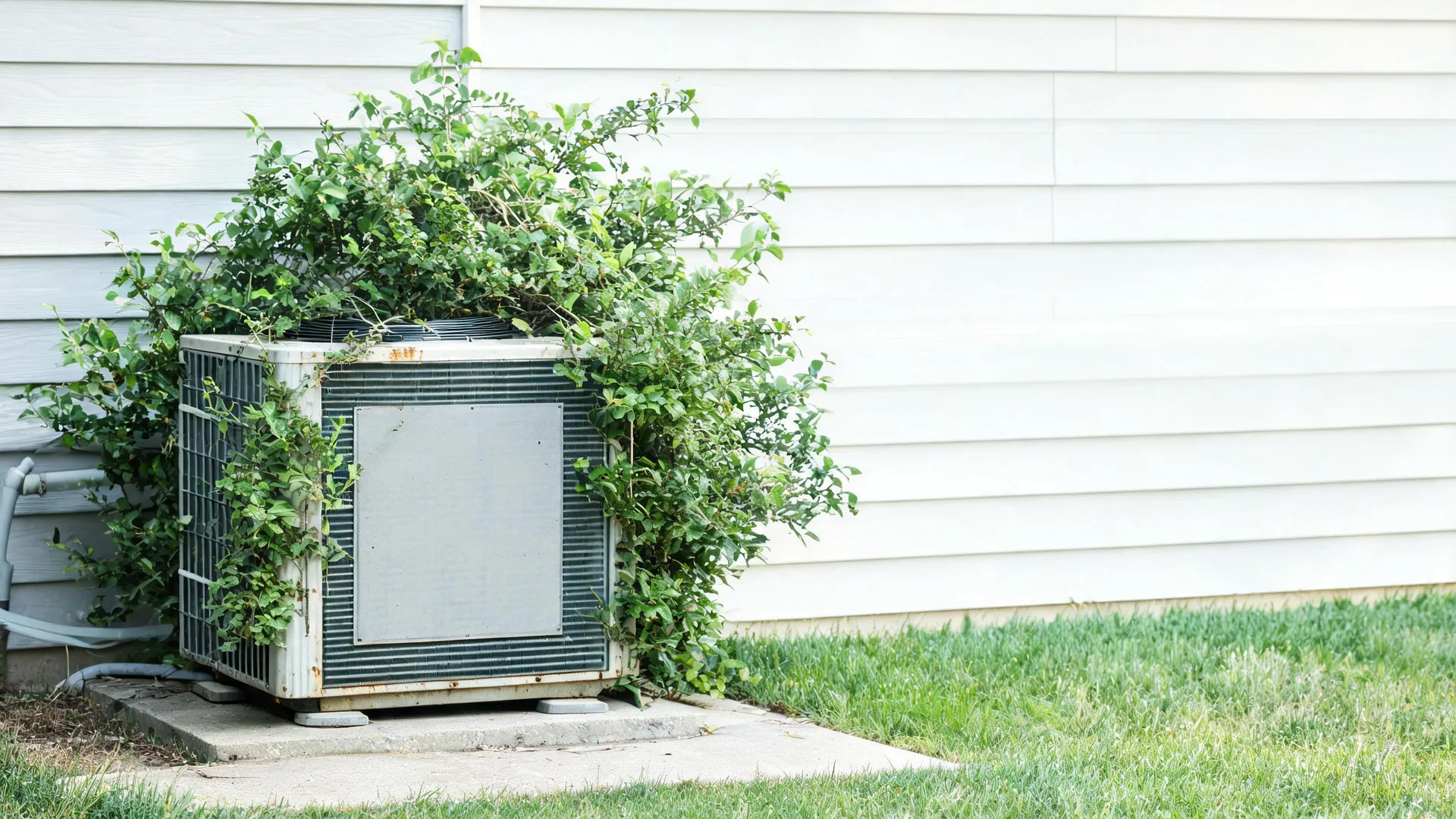
Look at the outdoor unit and clear away leaves, ice or anything blocking the coil or the fan. Check the indoor filter, since a clogged one restricts airflow enough to make a heat pump seem like it's failing when it just can't breathe. Make sure the thermostat is set to heat, not cool or auto, and swap the batteries if it uses them. Check the breaker box for anything tripped, outdoor unit and air handler are usually on separate breakers.

What to leave alone

Don't open the outdoor cabinet or touch the refrigerant lines. That work needs gauges, recovery equipment and a license, and a low charge has to be found and fixed, not topped off. Don't knock ice off the coil by hand or force the reversing valve, either one can bend a fin or damage the valve body. If the outdoor unit is caked in ice outside of a normal defrost cycle, or the breaker keeps tripping, shut the system off and wait for a technician instead of cycling it again.

A heat pump that's icing up, short cycling or tripping a breaker is telling you something is wrong right now, and running it anyway doesn't give that part a chance to recover. A reversing valve bleeding refrigerant past its seal only gets worse with use. The compressor keeps working against a system that isn't directing flow correctly, and that strain lands on a part that isn't built to absorb it. A dirty or icing coil causes the same kind of problem. The system has to run longer to move the same heat, the compressor runs hotter than it should, and a part that could have been replaced on its own starts to drag the compressor down with it. A breaker that keeps tripping means a motor or the compressor is pulling more current than it should, and resetting it just repeats the strain that tripped it in the first place. Not every odd noise means the system is about to fail. But an electrical or mechanical problem doesn't resolve itself by continuing to run, and a small failure left alone under load is usually how it ends up taking something bigger with it.

A diagnostic visit starts outside, with the unit running if it can run at all. A technician checks refrigerant pressure, amp draw on the compressor and fan motors, and the voltage reaching the reversing valve and defrost control. That shows whether the system has the charge and power it needs, and whether the parts meant to direct that power are doing their job. Inside, the air handler gets checked the same way, since a problem that shows up outdoors can trace back to a failing blower motor or a restricted coil. Most of this is done with gauges and a meter, not guesswork, and a tech can usually narrow a complaint down to a specific part before anything gets opened up or replaced. What the readings show determines what happens next. Sometimes it's a part on its way out with a straightforward swap. Sometimes the numbers point to something upstream of the part that's failing, and that changes what the actual fix needs to be.