A flat-roofed adobe house lit from within at dusk, surrounded by saguaro cacti and desert landscaping with mountains in the background.

Heat Pump Repair in Roswell, NM

Tell us about the job

Takes about a minute. No obligation.

RepairHeat PumpChaves County, NM
Step 1 of 2

What ZIP code is the job in?

A small fault asks the system to work around it

A heat pump with a weak capacitor, a low charge, or a frosted outdoor coil doesn't just run at reduced capacity. It runs longer to make up for it, and the parts carrying the extra load are the same ones already struggling. A compressor pulling hard against a low charge builds heat it wasn't built to handle. Keep it running and you're not getting by on a small problem anymore, you're turning it into a compressor replacement.

Ice and water don't stay put

A frosted coil or a clogged condensate line looks like it can wait, but ice spreads across the coil the longer the system runs, and a backed-up drain pan overflows onto whatever is underneath it. The fix today is a coil cleaning or a cleared line. Put it off while the system keeps cycling and you're looking at a damaged coil or water damage to the house on top of the original repair.

7 months
October through April, your system heats
5 months
May through September, it cools
27°F
the average winter night it heats against
93°F
the average summer afternoon it cools against
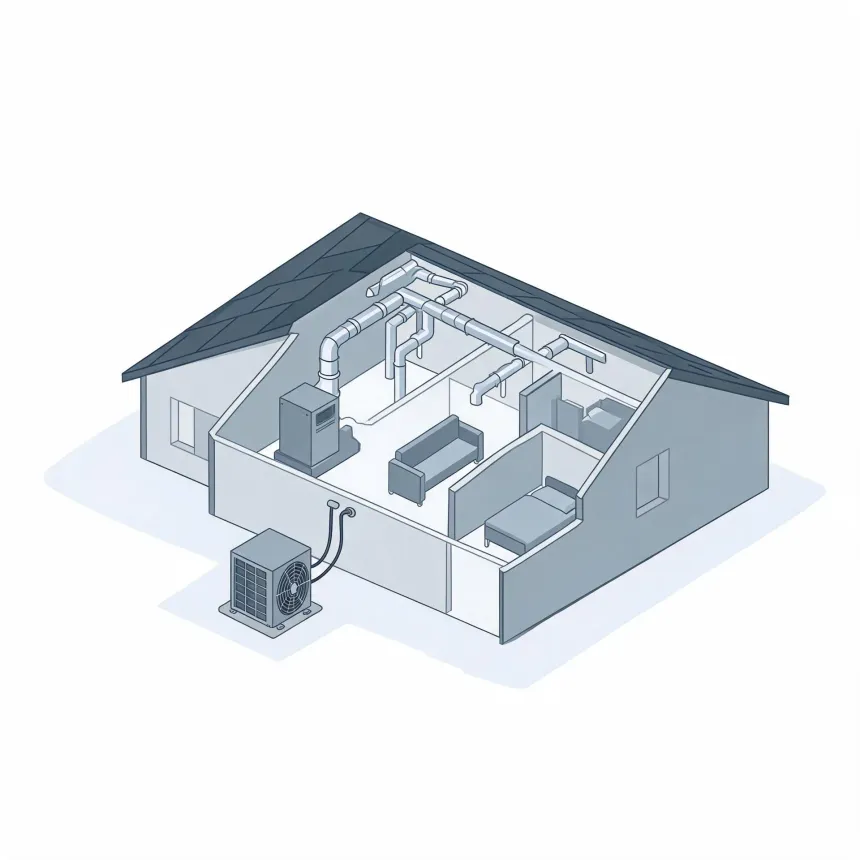
Isometric cutaway illustration of a single-story house showing interior rooms with furniture, an attic duct network connected to a furnace or air handler, and an outdoor condenser unit linked by lines outside the wall.
Your system heats October through April and cools May through September.

NOAA nClimDiv, 1991–2020 normals

September is the month before heat season starts in Roswell.

A heat pump with a weak part goes into October carrying that weakness into seven straight months of work.

Half the homes here were built in 1972 or earlier

Half the homes here were built by 1972
108 damaging wind events from 2015 to 2024
83 hail events from 2015 to 2024
Nothing unusual here, just a heat pump needing attentionWinter lows here average 27°F, about what any heat pump in this region is built to handle.

If your heat pump came with a house built around that time, ask the contractor one thing before approving a repair. How much life is left in the system. A compressor or coil repair makes sense on a unit with years ahead of it. It makes less sense on one already past the point where parts are easy to find or the rest of the system is close behind. A tech checking the heat pump can read its age off the nameplate and give you a straight answer on which side of that line it falls.

Get it looked at early

Problems tend to show up in the first weeks of the season, when the load hits a part that was already weak.

Find a contractor
A man in a dark long-sleeve shirt and tan work pants, seen from behind, carries a worn canvas tool bag up concrete steps toward a dark blue front door.
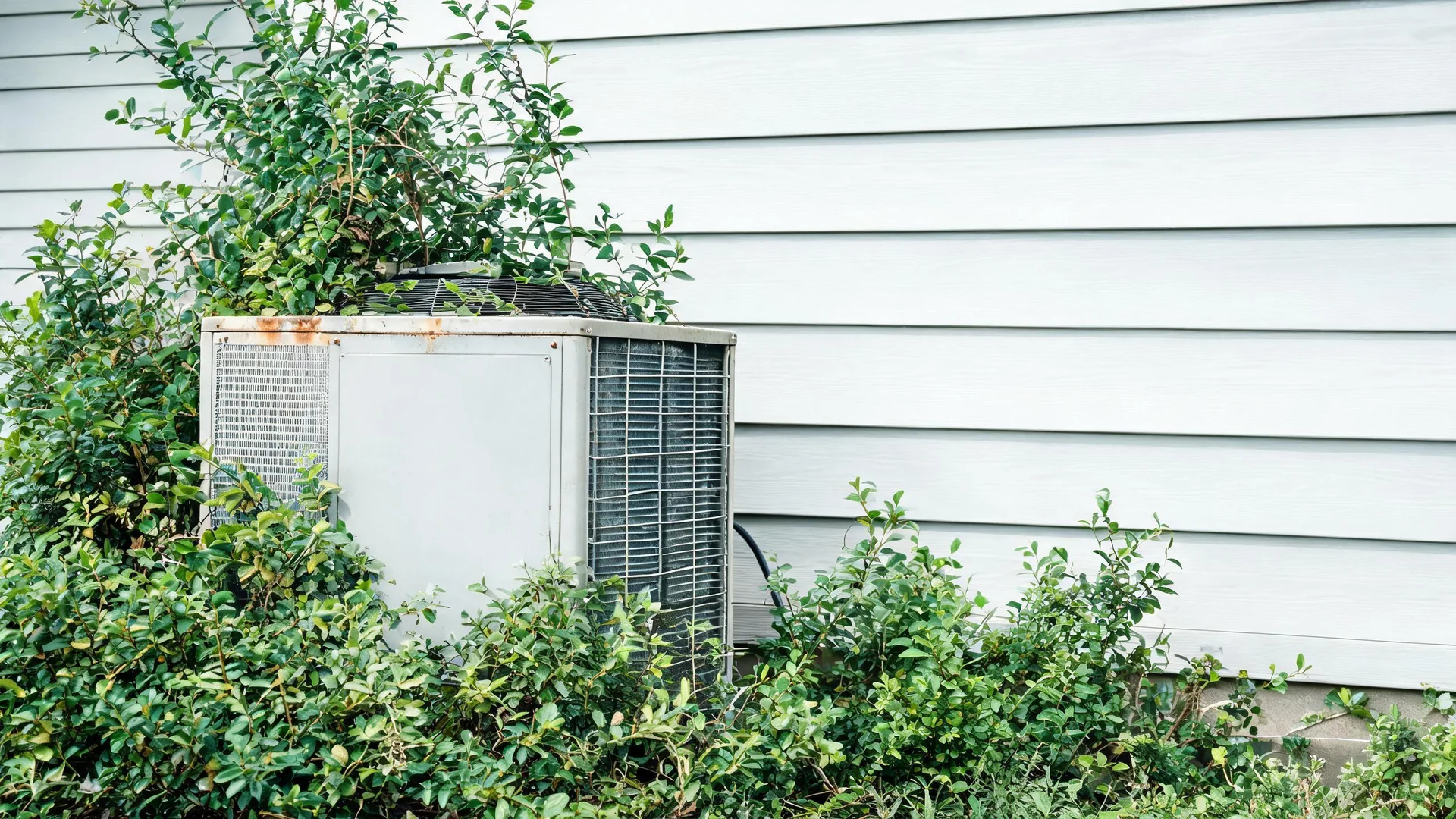
A gray heat pump outdoor unit mounted on a concrete pad next to a residential house with lap siding and stone accents.

What a heat pump tells you before it breaks

A heat pump that needs attention usually tells you before it quits outright. It runs longer than it used to, cycling on for stretches that used to be short. The air coming out of the vents feels cooler than it should, even while the system keeps running. Outside, the unit might be caked in frost that doesn't clear during the defrost cycle. You might hear it straining, a hum or a rattle that wasn't there before. Sometimes it's simpler than that. The outdoor fan isn't turning. Or the system switches between heating and cooling on its own without anyone touching the thermostat. A long run time can point to a low charge or a failing capacitor. Warm air that isn't warm enough can mean the reversing valve isn't fully shifting. Frost that won't clear usually means the defrost control or a sensor isn't doing its job. A heat pump already compensating for a weak part doesn't get better left alone. It runs that way until the part carrying the load gives out.

Most failures start outside

The outdoor unit carries the harder job. It sheds heat in summer and pulls heat from cold air in winter, so its fan motor, compressor, and coil take the wear. A fan motor bearing wears out. A compressor winding breaks down after running hot for too long. A coil picks up dirt and grime over time until it can't transfer heat the way it should.

The reversing valve is the part unique to this machine

A heat pump has to switch direction to go from cooling to heating, and that job falls to one valve. When its coil fails or the valve sticks partway, the system can get stuck in one mode or stop shifting cleanly between them. An air conditioner never has this part or this failure. A heat pump always does.

Before you call anyone, check the thermostat batteries and the breaker. Dead batteries or a tripped breaker look exactly like a failed system from where you're standing. Go outside and look at the unit itself. If the outdoor fan isn't spinning at all, or the whole unit is silent when it should be running, that's worth telling the tech before they arrive. Check the air filter too. A filter packed with dirt chokes airflow and can make a healthy system act like a failing one. Look at the outdoor coil for frost that hasn't cleared. None of this tells you what's broken, but it tells the tech what you've already ruled out.

A repair makes sense when the part that failed is the only part under strain. A bad capacitor, a stuck contactor, a failed sensor, these don't tell you anything about the compressor or the coil, so fixing them brings the system back to where it was. Replacement starts to make more sense when the compressor itself is the problem. It's the most expensive part in the system and the hardest to justify replacing on its own, since a compressor old enough to fail usually has a coil and a reversing valve that aren't far behind it. The other thing worth asking is how the system has been running up to this point. One failure is a repair. A string of unrelated breakdowns close together is telling you something about where the rest of the system stands.