



A flat-roofed adobe-style desert house photographed at twilight, surrounded by saguaro cacti and xeriscape landscaping.

Heat Pump Repair in Rio Rancho, NM

Tell us about the job

Takes about a minute. No obligation.

RepairHeat PumpSandoval County, NM
Step 1 of 2

What ZIP code is the job in?

Heat here runs about eight months a year, October through May, with June through August carrying the cooling load instead. A heat pump switches between the two jobs, and the switch itself is where trouble tends to show up. September is worth a call if things sounded off last spring, before the first cold morning asks the system to put out heat for real. Same in May, before the switch back to cooling. A part that was already marginal usually gives out in that first week of real demand, not in the easy weeks before it.

8 months
October through May, your system heats
3 months
June through August, it cools
19°F
the average winter night it heats against
85°F
the average summer afternoon it cools against
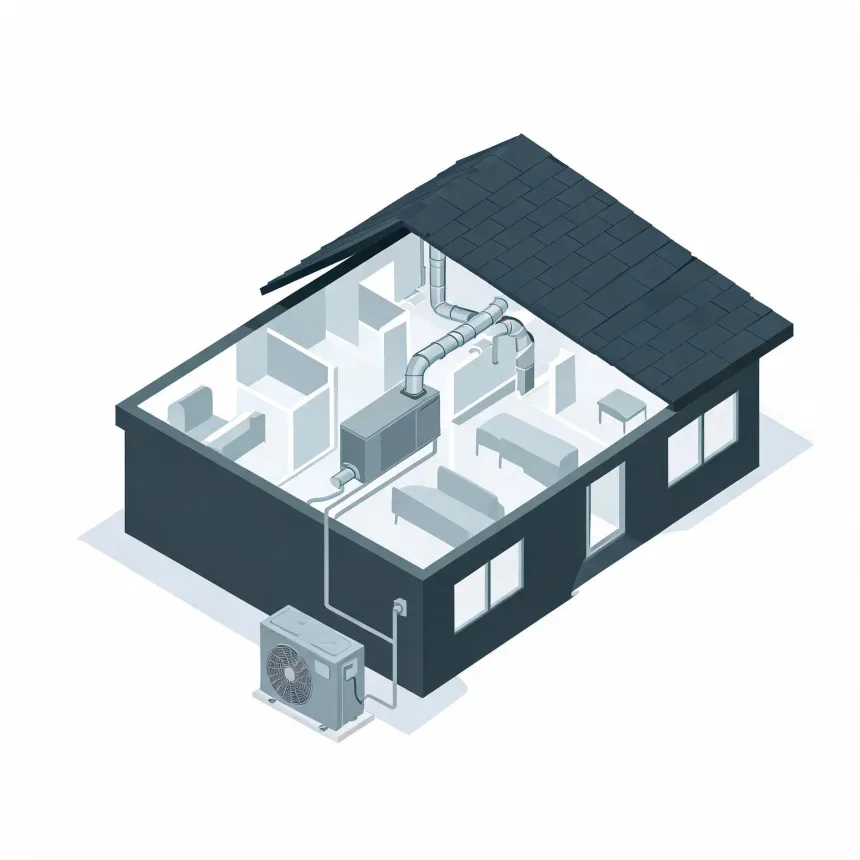
Isometric cutaway illustration of a single-story house showing interior rooms, ceiling ductwork connected to an air handler, and an outdoor condenser unit linked by a line set.
Your system heats October through May and cools June through August.

NOAA nClimDiv, 1991–2020 normals

Winter nights in Sandoval County average 19°F, cold enough that your heat pump runs its defrost cycle often.

A heat pump stuck in defrost or blowing cold air is usually a bad sensor or a reversing valve, not storm damage.

Nothing unusual here, just the usual wearSandoval County sees its share of wind, hail and winter storms, but none of it singles out a heat pump.

If your heat pump came with the house, it's worth getting a straight diagnosis instead of planning around a replacement. A reversing valve or defrost sensor is a small job on a system with years of compressor life left in it. Mobile homes are a smaller share of the housing here, so most of these calls are standard ducted systems, and the parts behind them are the usual suspects. Before anyone talks about a new unit, the question is whether the compressor still starts clean and holds pressure. On a newer system, it almost always does.

A newer system is usually worth repairing

Half the homes in Sandoval County were built in 1997 or later. If that's your house, the heat pump likely isn't old enough to be the reason it's acting up. A reversing valve or sensor is worth fixing on a system with years left in it.

Find a contractor
A man in a dark long-sleeve shirt and tan work pants, seen from behind, carries a worn canvas tool bag up concrete steps toward a dark blue front door.
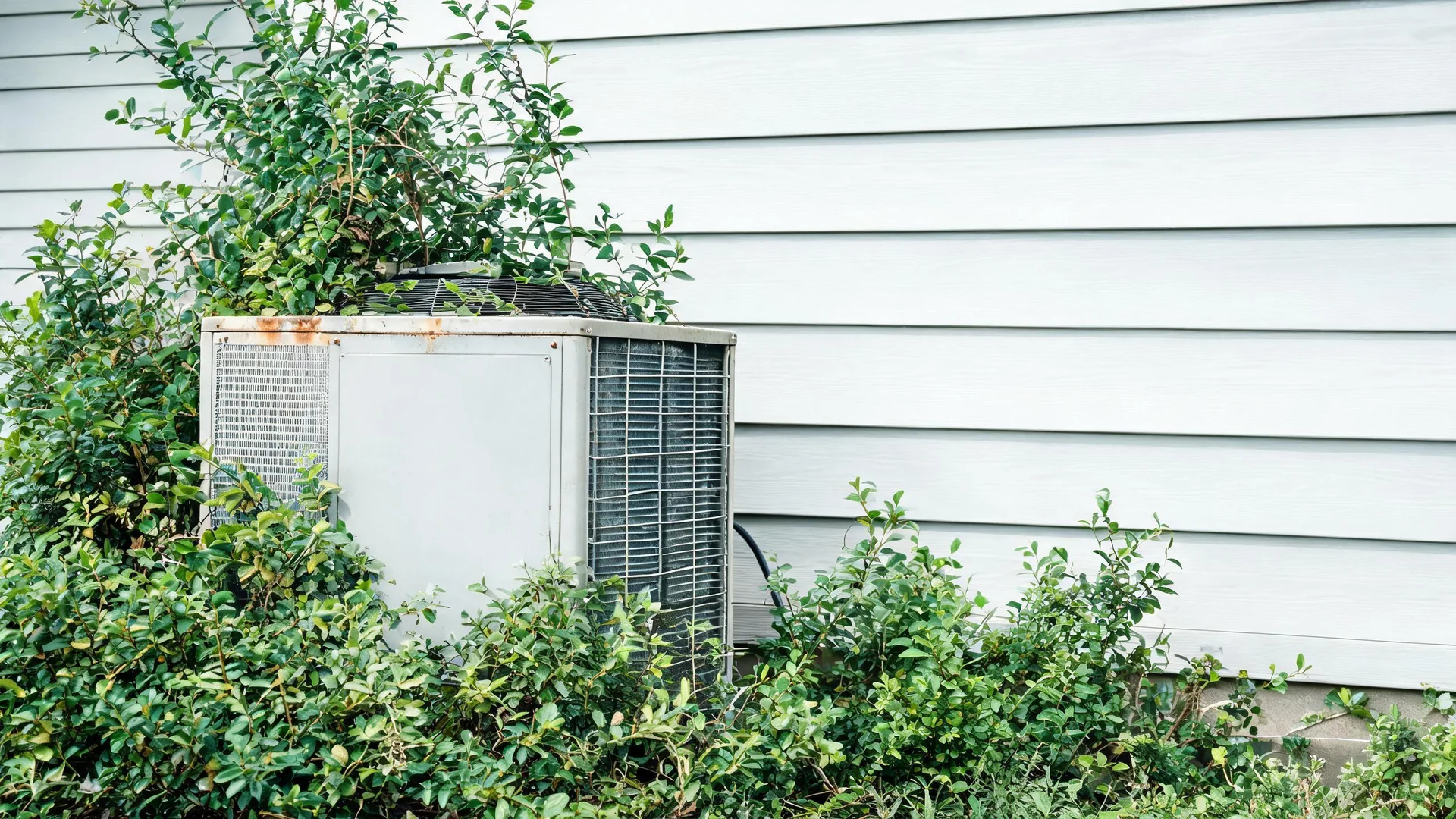
A gray heat pump outdoor unit mounted on a concrete pad next to a residential house with lap siding and stone accents.

What happens during the visit

A diagnostic visit starts with the tech asking what you noticed and when. Blowing cold air, running constantly, ice building up somewhere it shouldn't. That tells them which mode to chase first. Outside at the unit, they check refrigerant pressure and amp draw on the compressor, and they watch the reversing valve actually switch when it's told to. Inside, they check the sensors that tell the system when to start and stop defrost, and the board that reads those sensors. A tech worth hiring runs the system in both heat and cool before calling it, because a reversing valve that's stuck partway can look fine in one mode and fail in the other. Most of the time the visit ends with a part name. A bad sensor, a valve that won't seat, a capacitor that's weak but not dead yet. Rarely does it end with nothing found, because a heat pump that's acting up is almost always telling you exactly where to look if someone checks the right things in the right order.

What you actually notice first

Usually it's not a dead system, it's one that's still running but not doing its job. Air coming out barely warm, or cold when it should be warm. A unit that won't stop running, cycling on and on without ever satisfying the thermostat. Frost building up on the outdoor unit and staying there instead of clearing itself. Any of these mean something inside is failing, even though the system looks like it's working from the thermostat's point of view.
Sound and smell tell you something too

A heat pump that starts clicking repeatedly without starting up is often a capacitor too weak to get the compressor going. A hard clunk when the system switches between heat and cool is the reversing valve struggling to move. A burning smell from the indoor unit means power is going somewhere it shouldn't, and that one is worth shutting the system off for until a tech looks at it.

Most heat pump failures trace back to a handful of parts, and the reversing valve is the one unique to this kind of system. It's what switches the refrigerant flow between heat and cool, and the coil that drives it wears out or sticks after enough cycles, so the system gets stuck in one mode no matter what the thermostat asks for. The defrost sensor fails the same way a lot of thermostats do, it just reads temperature wrong, so the system either never defrosts and ices over, or defrosts constantly and never catches up on heat. Refrigerant charge runs low from a slow leak at a fitting or coil, and a heat pump low on charge struggles more than a straight AC would, because it leans on that refrigerant for both jobs. The compressor's start capacitor weakens with age and heat exposure, and once it's too weak the compressor tries to start, fails, and clicks off on its own protection, over and over. None of that is particular to one brand or one climate. It's how the machine is built, and it wears the same way everywhere.

A heat pump that's acting up isn't automatically near the end. Compressors are built to run for many years, and most of what fails around them, the capacitor, the sensors, the reversing valve, can be swapped out without touching the compressor at all. The question worth asking is whether the compressor itself is still sound. If it starts fine on a fresh capacitor and holds proper refrigerant pressure, the system has years left and a repair makes sense. If the compressor is the thing failing, struggling to start even with good power to it, or running but not building pressure, that's a harder call, since a compressor swap costs close to what a new outdoor unit costs. Age matters less than how the system has been maintained and how many of these parts have already needed replacing. A unit on its third capacitor in a few years is telling you something different than one that's never needed a repair before now.