







Illuminated timber-and-stone mountain cabins along a curved road at twilight, with lit trees and mountain peaks in the background.

Heat Pump Repair in Los Alamos, NM

Tell us about the job

Takes about a minute. No obligation.

RepairHeat PumpLos Alamos County, NM
Step 1 of 2

What ZIP code is the job in?

Heat runs here from September through May, close to nine months straight. August is the only real break, and it's usually when a weak part is sitting there doing nothing, waiting for the first real load to find it. A capacitor that's been fading all summer, or a low refrigerant charge, can go unnoticed until the system has to run hard and keep running. If your heat pump is short cycling, blowing air that isn't warm enough, or struggling to keep up once mornings turn cold, that weakness was probably already there. Getting it checked now means it gets fixed before the house is actually counting on it.

9 months
September through May, your system heats
19°F
the average winter night it heats against
80°F
the average summer afternoon it cools against
Isometric line illustration of a cutaway single-story house showing interior rooms, ceiling ductwork, an indoor air handler unit, and an outdoor condenser connected by a line set.

Cold is what works a heat pump here, not wind or hail or snow.

A unit with 19°F mornings on its record and no storm damage is usually just worn or neglected, and that's worth fixing.

At 14.2 cents a kilowatt-hour, a heat pump running wrong runs up your bill fast

Power costs 14.2 cents a kWh statewide
11 damaging wind events from 2015 to 2024
10 hail events from 2015 to 2024
Nothing about Los Alamos makes a heat pump failHalf the homes here were built in 1974 or earlier, half in 1974 or later. Age isn't the question. What's worn or broken is.

If your heat pump's acting up, it's not because something outside beat on it. No hail, no wind damage, nothing a storm did to the unit. Whatever's wrong got that way on its own, usually from age or from something that's needed attention for a while. That's good news for a repair call. A tech isn't hunting for storm damage or a cracked cabinet. They're checking the parts that wear out in any heat pump, the contactor, the capacitor, the reversing valve, the charge. Diagnosis is usually straightforward, and so is the fix once they find it.

A heat pump running wrong costs you every day it's not fixed

A heat pump that's running wrong doesn't pause while you think about it. It keeps pulling power at 14.2 cents a kilowatt-hour every hour it's stuck short cycling or struggling to keep up. Getting the actual cause checked now stops that.

Find a contractor
A man in a dark long-sleeve shirt, tan work pants and a cap climbs porch steps toward a gray door, carrying a canvas tool bag in his right hand, with a potted shrub to the right.
A residential heat pump outdoor unit mounted on a concrete pad next to a house with gray vinyl siding.

What actually wears out in a heat pump

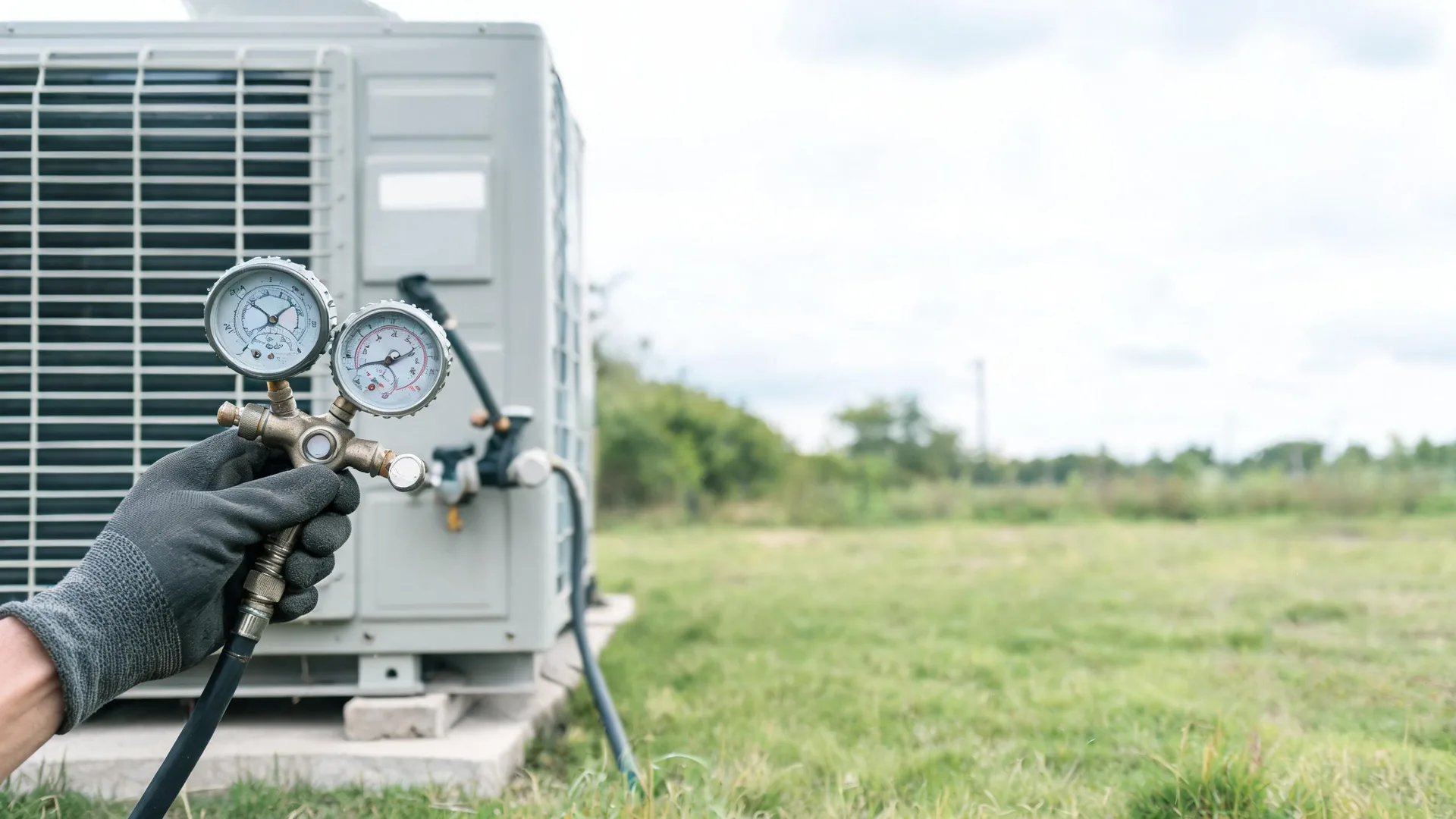
A heat pump runs the reversing valve every time it switches between heat and defrost, and that valve is usually the first thing to stick or leak when the system's been working hard for a long stretch. The contactor takes a hit too. Its contacts pit a little more with every cycle, and a short-cycling system runs through a lot more cycles than one left alone. The capacitor fades the same way, slow enough that nobody notices until the compressor or fan motor can't get the kick it needs to start. Low refrigerant charge is its own problem, usually a slow leak at a fitting or coil, and it shows up as a system that runs long and still can't keep the house where you set it. None of this is storm damage or bad luck. It's just what happens to the parts that cycle the most.

A weak part makes the compressor work harder

If the charge is low or a contact is pitted, the compressor does not just run a little worse. It pulls harder trying to hit the same heat output. That extra strain is what turns a weak part into a dead one, often faster than people expect once the system starts compensating for it.
Short cycling piles wear onto a few parts

A heat pump that keeps shutting off and restarting is loading the capacitor and the contactor every single time it starts. Weeks of that kind of cycling can wear those parts down more than months of normal running would, so what could have been a simple swap ends up taking the compressor with it.

Before you call, check a few things yourself. Make sure the thermostat is set to heat and the temperature is set above room temperature, since a setting bumped by accident looks exactly like a broken system. Go outside and look at the unit. If the coil is caked in ice or buried under leaves and debris, airflow is blocked and the system can't move heat right, and clearing it by hand can fix that on the spot. Check the air filter. A filter clogged with dust chokes airflow the same way, and swapping it is something you can do yourself. Walk through the house and make sure no vents are closed or blocked by furniture. If the outdoor fan isn't spinning at all, or you hear a hum but no motion, leave that alone. Past that, the reversing valve, the capacitor and the refrigerant charge all need a gauge and a meter to check safely, so that part's for a tech.

A tech's job on a repair call is to figure out which kind of failure this is, not to talk you into one path or the other. Some failures only ever mean a part swap. A bad capacitor, a pitted contactor, a stuck reversing valve all get replaced on their own, and the heat pump runs like it did before. The compressor changes the math. It's the most expensive part in the system, and when it's failing, the real question isn't whether it can be fixed. It's whether it's worth fixing on a unit that's already worn elsewhere. A tech checking one worn part usually looks over the rest of the system at the same time, because a heat pump old enough to lose a compressor is often old enough that other parts aren't far behind. The comparison that matters isn't this repair against a new system. It's this repair against the next one.