






An outdoor HVAC condensing unit on a concrete pad next to a beige single-story house with a dark shingle roof.

Heat Pump Repair in Fort Sumner, NM

Tell us about the job

Takes about a minute. No obligation.

RepairHeat PumpDe Baca County, NM
Step 1 of 2

What ZIP code is the job in?

May is when heat pumps here go back to cooling after sitting idle since fall. If a capacitor or contactor was already weak, the first hot stretch is what finishes it off. September works the same way in reverse, right before heat starts up for the seven months through April. A system that struggled last season usually struggles again at the same point in the next one. Getting it looked at now, rather than waiting for a full breakdown, is what keeps a small fix from turning into a no-cool or no-heat call.

7 months
October through April, your system heats
5 months
May through September, it cools
26°F
the average winter night it heats against
91°F
the average summer afternoon it cools against
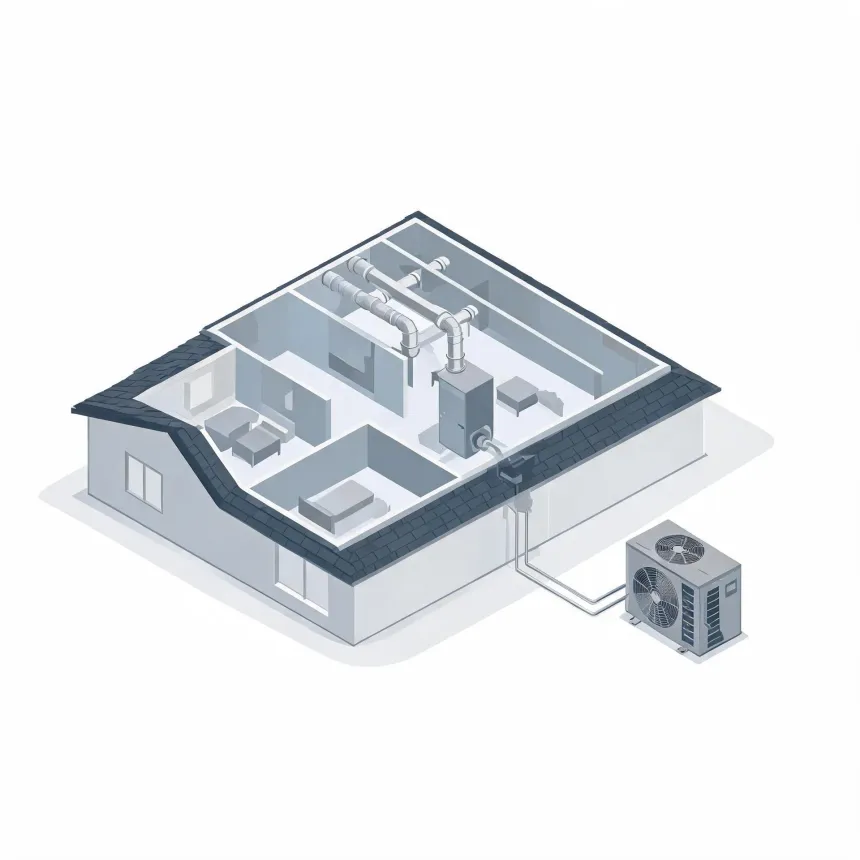
Isometric cutaway illustration of a single-story house showing interior rooms with ductwork, a furnace or air handler, and refrigerant lines running outside to a condenser unit on a pad.
Your system heats October through April and cools May through September.

NOAA nClimDiv, 1991–2020 normals

Fort Sumner winters run cold, with overnight lows near 26°F through December, January and February, but nothing like the wind and hail De Baca County sees.

A heat pump here isn't fighting extreme heat or getting pounded by storms every season, so if yours is struggling, age or a worn part is the more likely reason, not the climate.

Fort Sumner isn't why your heat pump is struggling

Power costs 14.2 cents a kWh statewide
50 damaging wind events from 2015 to 2024
37 hail events from 2015 to 2024
Fort Sumner isn't why your heat pump is strugglingHalf the homes in De Baca County were built in 1977 or earlier, and age is the more likely reason a heat pump here is giving trouble.

That's worth knowing before you decide whether a repair is worth paying for. A heat pump that hasn't spent years fighting hail or wind damage is usually sound underneath whatever's gone wrong with it. The cabinet, the coil, the refrigerant lines, all the parts that take a beating from weather elsewhere, are more likely to still be in working order here. So if a contractor finds the problem is a failed capacitor or a worn contactor, replacing that part is usually enough. It's not a sign the whole unit is on its way out.

Get it looked at early

Problems tend to show up in the first weeks of the season, when the load hits a part that was already weak.

Find a contractor
A man in a cap, gray long-sleeve shirt and brown pants carries a canvas tool bag up porch steps toward a dark front door, beside a potted shrub.
A gray air-source heat pump mounted on a concrete pad next to a house with gray vinyl siding, surrounded by gravel and flanked by green shrubs and white hydrangea flowers.

Running it longer doesn't buy you time

A struggling part rarely fails clean. It fails a little, then runs that way under full load, and running makes it worse. A weak capacitor still starts the compressor, just slower and with more strain each time, until the day it can't push it at all. A contactor with pitted contacts arcs a bit more on every cycle, heating itself up more than it should, which pits it further. Ice on the outdoor coil blocks airflow, so the compressor works harder to move heat through less air, and a compressor running hot shortens its own life. A reversing valve that's starting to stick will still complete the switch most times, right up until it doesn't, and forcing it back and forth under a full call for heat is what finishes it off. None of these get better by waiting through another cycle.

What you can check yourself

Start at the outdoor unit. If the fan isn't turning at all, check the breaker before anything else. A tripped breaker looks exactly like a dead system but isn't one. Inside, check the thermostat is set to the mode you actually want and the batteries aren't dying, since a blank display won't call for heat or cooling no matter what's wrong outside. Check the air filter too. A filter packed with dust chokes airflow across the indoor coil, and the system can ice up or shut itself down trying to push air through it.

What to leave alone

If you see ice on the outdoor coil, don't chip at it or hose it down. A heat pump clears its own coil through a defrost cycle, and ice that isn't melting off means that cycle failed, not something you can fix by hand. Leave the refrigerant lines and anything behind the outdoor unit's panels alone too. Those take gauges and training to touch safely. And if a breaker trips a second time after you reset it, stop resetting it. That's the system telling you something is actually wrong, not asking for another try.

Most calls start with the system running but not doing its job. Air blows from the vents but it feels like room temperature, so the house slowly drifts off target instead of catching up. Short cycling is another one. The system kicks on, runs a couple minutes, shuts off, then starts again a little later, never finishing a full run. Some homeowners hear it before they feel it, a clicking at the outdoor unit when it tries to start, or a hum with no fan turning. In heating mode, air that feels barely warm at all often means the reversing valve isn't fully switching over. A system stuck in one mode, cooling when you asked for heat or the other way around, points to that same valve stuck partway. None of these fix themselves. Running a struggling system longer just adds wear to whatever's already failing.

Once something's actually failed, the question is whether it's one part or the whole system. A capacitor, a contactor, a defrost sensor, these are cheap to make and cheap to swap, and replacing one doesn't say anything bad about the rest of the unit. A compressor is different. It's the one part that isn't really a repair so much as a decision, since a new compressor costs enough that most people weigh it against a whole new system anyway. Refrigerant leaks sit in between. A single leak at a fitting is a fair repair. A coil that's corroded through and leaking in several places is a sign the coil is done, not something worth patching. The age of the part matters less than what broke and why. A capacitor just wears out from running, and a new one goes back to normal. A compressor that failed from years of low refrigerant was already being damaged before it quit, and that history doesn't go away with a repair.