A flat-roofed adobe-style desert house photographed at twilight, surrounded by saguaro cacti and xeriscape landscaping.

Heat Pump Repair in Carlsbad, NM

Tell us about the job

Takes about a minute. No obligation.

RepairHeat PumpEddy County, NM
Step 1 of 2

What ZIP code is the job in?

The tech traces the cause before touching a part

A heat pump that won't heat or cool can trace back to the reversing valve, a low refrigerant charge, the defrost control board or a failed contactor. The tech hooks up gauges, checks pressures and temperatures at the lines, and tests the electrical components to see which one is actually behind the problem. Guessing wrong means paying for a part that was never the issue.

The visit tells you what kind of problem this is

A stuck reversing valve or a failing compressor points toward a bigger decision about the unit itself. A bad capacitor or a loose wire is a different kind of problem entirely, often fixed on the spot. Until the system is actually checked, there's no way to know which one you're dealing with.

5 months
November through March, your system heats
5 months
May through September, it cools
31°F
the average winter night it heats against
94°F
the average summer afternoon it cools against
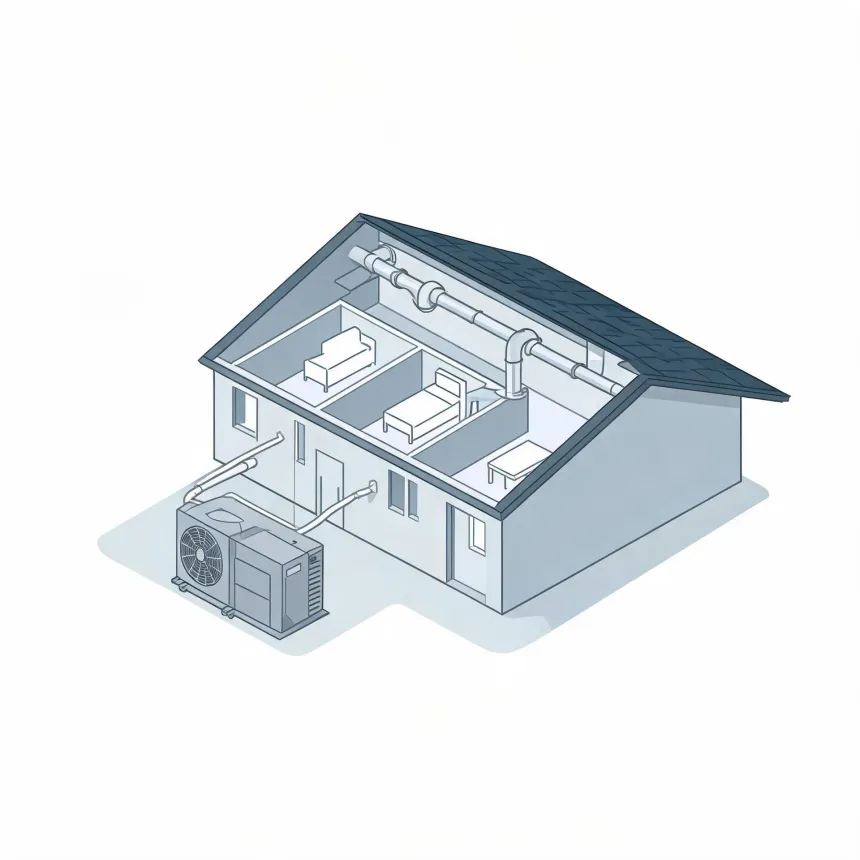
Isometric line illustration of a cutaway single-story house showing interior rooms with furniture and attic ductwork connected to an outdoor condenser unit beside the building.
Your system heats November through March and cools May through September.

NOAA nClimDiv, 1991–2020 normals

Eddy County saw 344 severe weather events between 2015 and 2024, most of them wind and hail.

A heat pump here fails for the same reasons it fails anywhere else. A worn capacitor, a low charge, a control board that's given out.

Carlsbad heat pumps earn their keep from November through March, then again May through September

Cooling runs May through September
Heat runs November through March
222 damaging wind events from 2015 to 2024

Half the homes in Eddy County were built in 1980 or earlier, half later, and that split doesn't say much about the heat pump outside. The unit's age depends on when it was last replaced, not when the house went up. Mobile homes make up a share of the housing here too, and those often run a smaller heat pump or a packaged unit, but the parts inside fail the same way they do in any other home. A reversing valve or a capacitor doesn't act differently because of what kind of house it's bolted to.

Your heat pump works overtime here. Get the real problem fixed.

This heat pump runs nearly year round here, through summer heat and winter cold, and that kind of duty adds up. A part that's already worn doesn't get better on its own. Have it looked at and fixed right the first time.

Find a contractor
A white mini-split heat pump outdoor unit mounted on a concrete pad beside a gray-sided house, surrounded by gravel and green shrubs.

What you can check yourself first

Before anyone comes out, a few things are worth checking yourself. Look at the outdoor unit and clear away anything blocking it, leaves, dirt, a stray branch, so air can move through the coil. Check the thermostat is set to the right mode and the temperature actually calls for heating or cooling, not sitting right where it already is. Go to the breaker panel and make sure the breaker for the unit hasn't tripped. If the system has a condensate line, look for a switch near the drain pan that shuts the unit off when the line backs up, that alone can stop a system cold. Pull the air filter and hold it to the light. If you can't see through it, swap it, a clogged filter starves the coil of airflow and can ice it over. If the outdoor unit is caked in ice outside of a normal defrost cycle, don't chip at it or force it, that points to a problem worth having looked at. None of this calls for opening the unit or touching refrigerant lines, that part is for the tech.

A small problem can turn into a bigger one

A heat pump low on refrigerant will keep running, but the compressor works harder to move what charge is left. Run it like that long enough and the compressor itself can fail, which turns a refrigerant leak into a full unit replacement.

Ice is the clearest warning sign

A heat pump that can't complete a normal defrost cycle will start icing over the outdoor coil. Keep running it and that ice blocks airflow completely, so the system pulls in heat it can't use and strains components that were never the original problem.

Most people notice a heat pump problem before they could name it. The air coming out feels wrong, cool when it should be warm, or warm when it should be cool. Sometimes it just moves air without doing much to the temperature. Some notice the unit running all the time without the house catching up. Others notice it short cycling, kicking on and off every few minutes instead of settling into a run. A rattle from the outdoor unit, a hum with no fan turning, or a clicking that never resolves into the system starting are all worth paying attention to. A burning smell from the vents or a breaker that trips when the system switches between heating and cooling points to an electrical fault, not something to run again and see if it clears. Any of these is worth a call before it turns into a bigger repair.

A heat pump that's old and losing refrigerant or showing signs of a weak compressor is usually not worth sinking money into, since the compressor is the most expensive part to replace and a unit that needs one is close to needing all of it. One that's otherwise sound but tripped up by a bad capacitor, a failed contactor or a control board is a different story, those are routine repairs that bring the system right back to normal. The pattern matters as much as the part. A unit that's needed a few different repairs over a couple of years is telling you something about where it's headed, even if each fix was small on its own. A system still under warranty almost always favors repair, since the cost of the part itself isn't the homeowner's problem yet. Age on its own isn't the deciding factor, how the unit has held up matters more than how long it's been running.