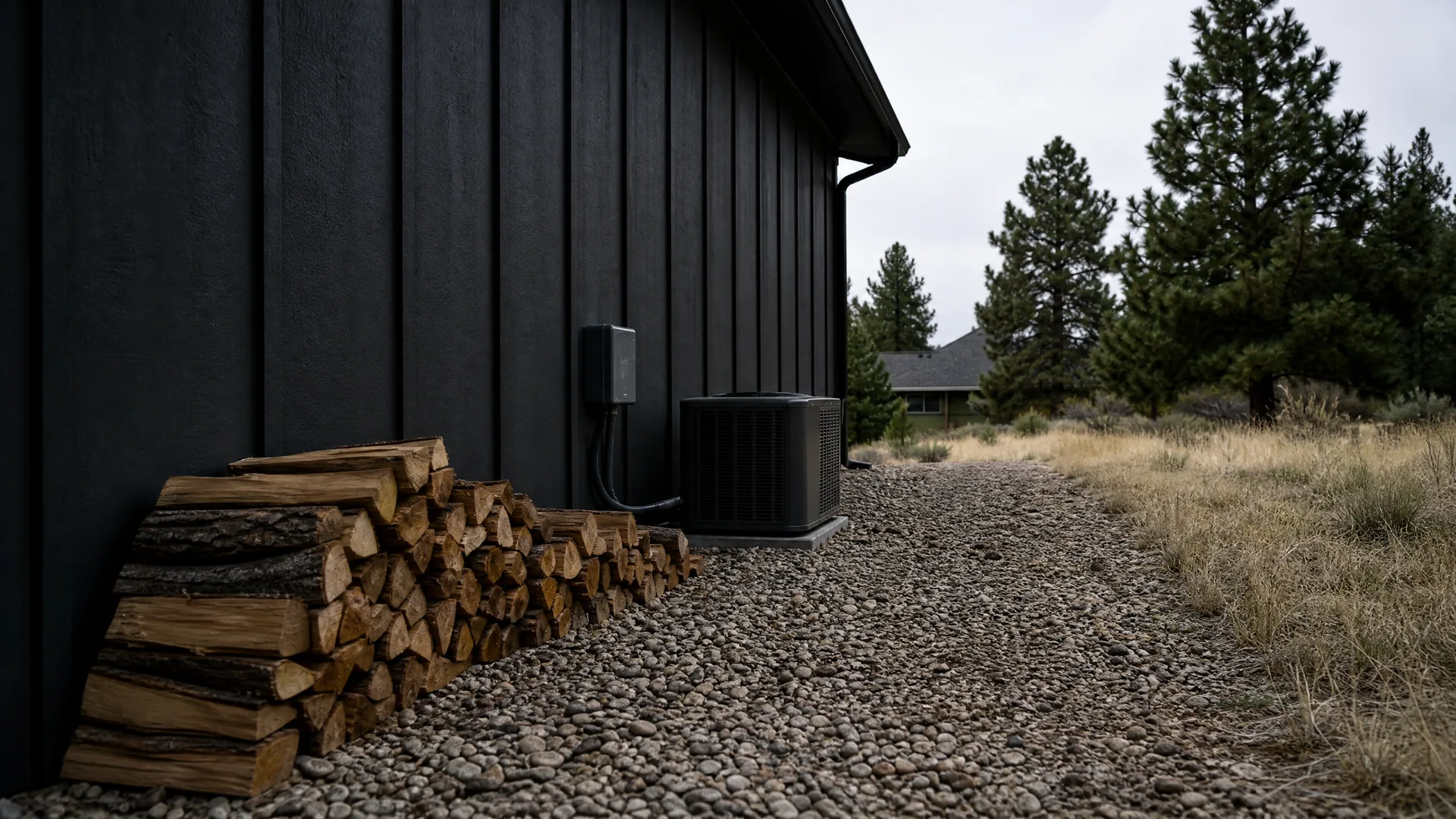
Exterior corner of a dark board-and-batten house with a stacked firewood pile, an electrical box and an outdoor condenser unit on a gravel bed, with dry grass and pine trees under an overcast sky.

Heat Pump Installation in Wagon Mound, NM

Tell us about the job

Takes about a minute. No obligation.

New system or replacementHeat PumpMora County, NM
Step 1 of 2

What ZIP code is the job in?

A standard heat pump size fits most homes here

Half the houses in Mora County were built in 1983 or earlier, which usually means a straightforward load for a heat pump, nothing oversized needed. A contractor sizing your system will still measure your actual house, but there's no local reason to expect a bigger unit than normal.


Mobile homes need the matching equipment

Close to a quarter of the homes in Mora County are mobile homes. If yours is one, the installation calls for equipment and ductwork rated for a mobile home, not a standard system adapted to fit. Tell the contractor this upfront so they bring the right unit.

9 months
September through May, your system heats
18°F
the average winter night it heats against
81°F
the average summer afternoon it cools against
Isometric line illustration of a cutaway house showing interior rooms with furniture, ceiling ductwork under a dark shingled roof, and an outdoor condenser unit connected by lines on the right.

A heat pump's rating on paper is tested at mild outdoor temperatures.

Ask what it actually puts out once it's cold outside, since that's the number that tells you if it'll keep up.

Nothing about Wagon Mound pushes you toward a bigger or pricier heat pump

Power costs 14.2 cents a kWh statewide
98 damaging wind events from 2015 to 2024
39 hail events from 2015 to 2024

Mora County has logged 217 severe weather events over the past decade, counting windstorms, winter storms, hail and a handful of tornadoes. None of that changes what size heat pump your house needs. Sizing comes from your square footage, your walls, your windows, not the storm count outside them. What the weather does affect is the power behind the unit. Statewide, a good share of New Mexico households lost power for a full day or more last year, and a heat pump only runs as well as the electricity feeding it. Worth asking your contractor whether backup heat makes sense for your setup, separate from the question of size.

Get it in before September, while you still have time to get it right

Heat here runs nine months, September through May. August is the one month before that starts, and it's the better time to put in a new heat pump, with the old one still working if something needs adjusting and no rush to get heat back on the same day.

Find a contractor
A man in a cap, long-sleeve navy shirt and tan work pants walks up porch steps toward a dark front door, carrying a canvas tool bag in his right hand, with a potted shrub to the left.
A gray heat pump outdoor unit mounted on a concrete pad next to a residential house with lap siding and stone accents.

Sized for the house, not guessed at

A heat pump that's too big cycles on, satisfies the thermostat fast, and shuts off before it's pulled the moisture out of the air or warmed the place evenly. One that's too small runs flat out and still can't keep up when it's cold, so the backup heat kicks in more than it should. Sizing isn't a guess. A contractor works it out room by room. Square footage, how many windows and which way they face, how much insulation is in the walls and attic, how airtight the place is. That math is called a load calculation, and it's what tells you the right tonnage, not the size of the unit you're replacing. An old system sized wrong is not a reason to repeat the mistake.

The old equipment gets hauled away

Whoever installs the new heat pump disconnects the old unit, the outdoor condenser or heat pump, and takes it with them. The refrigerant inside has to be recovered first, not vented, so it's handled as part of the removal rather than just scrapped on the spot.

The ductwork usually stays

If the house already has ducts, the new heat pump typically connects to them rather than replacing them. Worth asking whether the existing ducts are sized right for the new system, since a duct run built for an old furnace doesn't always move enough air for a heat pump.

What drives the price isn't just the unit sitting outside. A heat pump that has to work with the existing ducts costs less to put in than one where the ducts need resizing or rerouting, since moving air through a trunk line that's too narrow is a different job than running new line sets. The electrical panel matters too. Some homes have enough capacity for a heat pump already, others need the panel upgraded before the unit can even be wired in, and that's its own separate job with its own separate cost. Backup heat strip or not changes the install as well, since adding one means more wiring and a bigger draw on the panel. And where the outdoor unit ends up, how far it sits from the panel and from the indoor coil, decides how much line and wire has to run between them. None of that shows up on the sticker price of the equipment itself.

Install day starts with the old system coming out, then the new one going in, so expect the house to be without heat for part of the day. The outdoor unit gets set on a pad or bracket, the indoor coil gets connected, and the line set between them gets run and sealed. Once the lines are connected, the installer pulls a vacuum on them to clear out air and moisture before the refrigerant goes in, since either one left in the line will keep the system from working right down the road. Electrical hookup comes next, tying the unit into the panel and setting the disconnect box outside. Before anyone leaves, the system gets run in both directions, heat and cooling, and checked against the refrigerant charge it's supposed to have. Walk the thermostat settings with whoever installs it before they go, so you know how it behaves differently from your old system.