Gas heats most homes here
Utility gas heats 49.2% of occupied homes in Sierra County, with electricity at 30.7% and propane at 14.6%. A gas furnace is still what most houses in Truth or Consequences have in the closet or the utility room right now.
Takes about a minute. No obligation.
Utility gas heats 49.2% of occupied homes in Sierra County, with electricity at 30.7% and propane at 14.6%. A gas furnace is still what most houses in Truth or Consequences have in the closet or the utility room right now.
Putting in a heat pump here usually means taking out a gas furnace and wiring in electric heat instead of swapping one box for another. That changes the breaker panel and the ductwork sizing a contractor will need to check, not just the unit outside.
NOAA nClimDiv, 1991–2020 normals
Heat pump installs booked for September fill up fast, right before heat season starts in October.
Get it done in May or June instead, while a contractor can still take the time to size the ductwork right.



Electricity here runs 14.2 cents a kilowatt-hour, below what most of the country pays. That changes the math on a heat pump a little. The efficiency gain still cuts your bill next to electric resistance heat, but with power this cheap the payback stretches out longer than it would somewhere expensive. So the case for a heat pump here rests less on shaving dollars off your bill and more on whether it's sized right and holds up. A unit that's matched to your ductwork and your house will run fine for years. One that isn't will cost you in comfort before it costs you in cents per kilowatt-hour.
Sierra County falls in zone 3B, and any split-system heat pump installed now has to clear 14.3 SEER2 for cooling and 7.5 HSPF2 for heating at minimum. That's a federal floor, not a ceiling, and it narrows down which units a contractor will even bring you as options.
Find a contractor
Half the houses in Sierra County were built in 1983 or earlier, half in 1983 or later. That split doesn't call for a bigger or pricier heat pump either way. What decides the size is the ductwork already in the house, and a contractor checks that on any install no matter when the house went up. Mobile homes are 41.4% of the housing stock here, more than most counties see. That does change things. A mobile home usually needs a system sized and configured for that kind of construction, not the same unit you'd put in a site-built house. Outside of that, nothing about homes here pushes you toward a bigger unit or a higher tier. A correctly sized heat pump at the federal minimum will run here the same as it would anywhere in this climate zone.
An oversized heat pump blasts the house up to temperature fast, then shuts off. A few minutes later it kicks back on. It never runs long enough to pull moisture out of the air or settle into a steady rhythm. Rooms farther from the air handler end up warmer or colder than the rest of the house, and the compressor wears out faster from all the starting and stopping.
A contractor works out the right size by doing a load calculation on the house itself. Square footage, window placement, insulation, how many walls face the sun, all of it factors in. That number is what tells them which heat pump to install and whether the existing ductwork can even move that much air. The old furnace sitting in the closet doesn't enter into it.
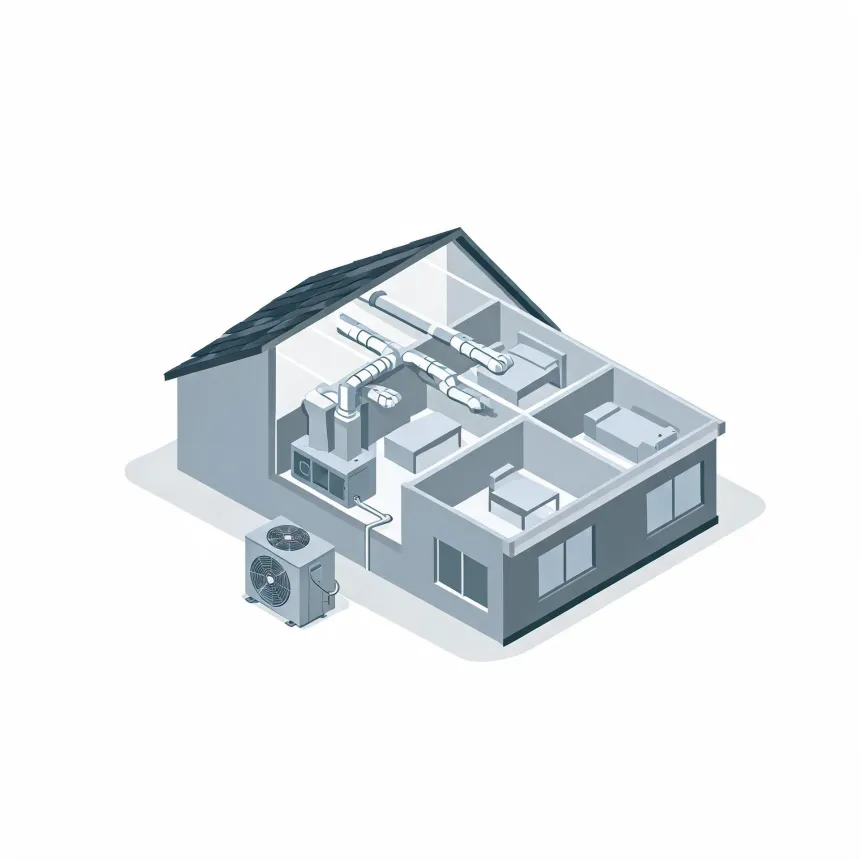
If the old system is a gas furnace, it comes out, not just the outdoor condenser. The gas line gets capped off by whoever handles that trade, and the furnace and its flue get hauled away. If there was a separate AC unit alongside the furnace, both go, since the heat pump replaces that whole setup with one system that heats and cools. The thermostat usually gets swapped too, since a heat pump needs one built for it rather than one wired for gas heat and electric cooling. None of this touches the ductwork already running through the house. That stays, and a contractor works with what's there or modifies it, rather than tearing it out along with the old equipment.
Install day starts with the old equipment coming out. That takes longer than people expect when a furnace is involved. Once the space is clear, the indoor coil and air handler go in, then the line set gets run out to where the outdoor unit sits. That line set gets brazed, pressure tested, and pulled down to a vacuum before any refrigerant goes in. Trapped air and moisture left in the lines will wreck a compressor over time. A heat pump draws power differently than a gas furnace did, so the disconnect box and breaker get matched to the new unit rather than left as they were. Toward the end of the day a contractor fires up the system, checks the refrigerant charge, and measures the airflow at the vents to confirm the ductwork is moving what the unit expects. The thermostat gets programmed last, once everything else is running.