A twilight street scene featuring illuminated timber-frame and stone houses with a mountain range visible in the background.

Heat Pump Installation in Los Alamos, NM

Tell us about the job

Takes about a minute. No obligation.

New system or replacementHeat PumpLos Alamos County, NM
Step 1 of 2

What ZIP code is the job in?

Electricity here runs 14.20 cents a kilowatthour

New Mexico households pay more for power than most of the country, and a heat pump that heats and cools your whole house runs on that power every day it operates. How efficiently it converts that electricity into heat matters more here than in a state with cheaper rates.

Efficiency is what you're buying, not just equipment

When you're comparing heat pumps for this house, the efficiency rating is doing real work on your bill, not just a number on a spec sheet. A unit that uses less electricity per degree of heating or cooling it delivers will cost less to run every single month it's working, which in Los Alamos is most of the year.

9 months
September through May, your system heats
19°F
the average winter night it heats against
80°F
the average summer afternoon it cools against
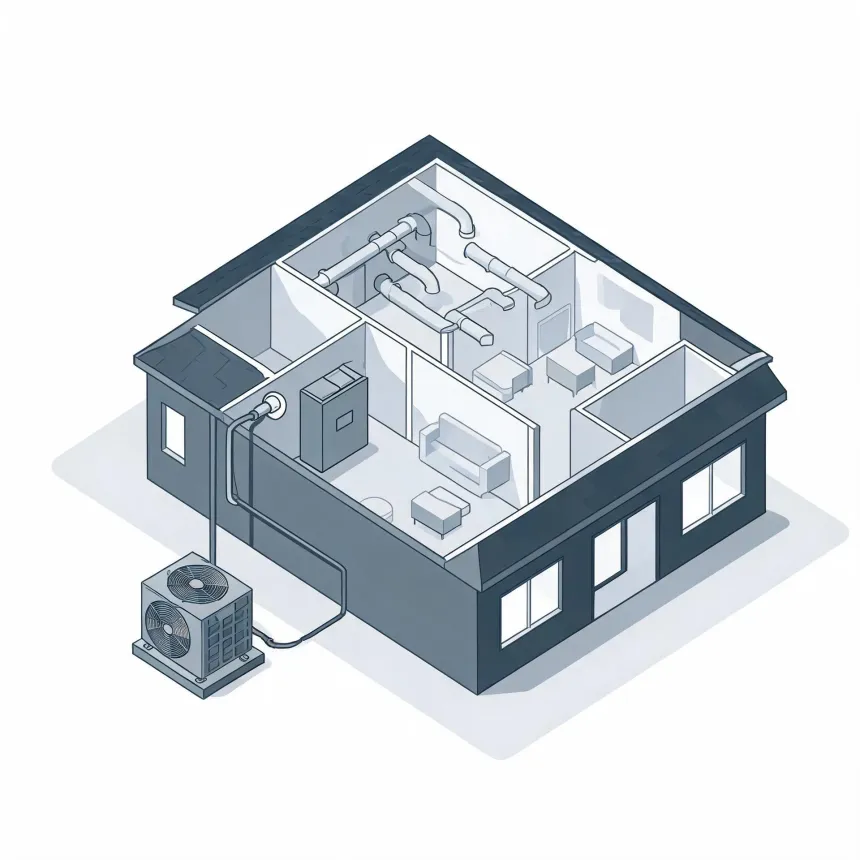
Isometric line illustration of a cutaway single-story house showing interior rooms, ceiling ductwork and an indoor air handler, connected by a line to an outdoor condenser unit on a pad beside the building.

A heat pump in Los Alamos isn't fighting the kind of heat that wears a compressor down fast.

Less strain means a straightforward model holds up fine, you don't have to pay for the top tier to get years out of it.

Most houses here heat with gas

81.6% of homes heat with gas
11 damaging wind events from 2015 to 2024
10 hail events from 2015 to 2024
Nine months of heat a yearHeat runs September through May here. Get it in before August is out.

Whether your house was built in 1974 or earlier, or in 1974 or later, doesn't change what size heat pump it needs. A contractor sizes the system to your square footage, your windows and how the house is insulated, not to its age. Los Alamos County splits about evenly on either side of that line, and that split doesn't point toward bigger equipment or smaller. A correctly sized, standard-efficiency heat pump will heat and cool a house from either era just fine. What matters is getting the load calculation right for your particular house, not matching some countywide trend.

Any heat pump going in here has to clear zone 5B's minimum

New Mexico requires 14.3 SEER2 and 7.5 HSPF2 on heat pumps installed from 2023 on, and central air has its own EER2 floor alongside that SEER2 number. That's the baseline a contractor has to meet here, not a ceiling. A federal tax credit is available on top of it.

Find a contractor
A man in a gray polo shirt and tan work pants carries a worn canvas tool bag up porch steps toward a closed gray front door, with a potted shrub beside the entry.
A gray heat pump condenser unit mounted on a concrete pad against the gray lap-siding exterior wall of a house.

Built for weather, not for strain

Winter storms hit this county 31 times between 2015 and 2024. That's weather the installation has to handle, not the compressor. A heat pump here isn't working against extreme heat day after day, so the strain that wears down a compressor over time just isn't there. Put the money into solid equipment and a correct installation instead of the highest efficiency tier on the shelf. A mid-range heat pump, sized right for your house and installed to hold up through snow and ice, will serve you fine.

Bigger isn't better here

A heat pump too big for the house will short cycle. It runs in bursts that never last long enough to pull moisture out of the air or settle into a steady output. One that's too small runs constantly and still struggles to keep up on the coldest mornings. Either mistake shows up in comfort and in wear on the compressor. Matching output to the house is the whole job, not a detail of it.

The load calculation is the real work

A contractor sizes the system by working through a load calculation. They look at square footage, ceiling height, window area and type, insulation levels, how many exterior walls each room has, and which way the house faces. That work tells them how much heat the house loses in winter and gains in summer. The heat pump gets matched to that number, not to the size of the system it's replacing and not to a rule of thumb per square foot.

If you've got a furnace or AC unit being replaced, it doesn't just disappear. A contractor disconnects the refrigerant lines, recovers whatever refrigerant is left in the old system rather than letting it vent into the air, and that recovery is required, not optional. The old outdoor unit, indoor coil and any line set being replaced get hauled off. Ductwork usually stays, since a heat pump can often use what's already run through the house, though a contractor checks it for leaks and proper sizing before tying the new equipment into it. If the old system ran on gas and the heat pump is taking over heating duty, the gas line gets capped off safely rather than left live with nothing using it. Scrap metal from the old unit typically gets recycled, since the coils and cabinet are worth something as scrap rather than landfill waste.

Ask about the sound rating on the outdoor unit, since one sitting near a bedroom window or a patio matters more than the spec sheet suggests. Ask what refrigerant it uses, since that affects how easily a contractor can get parts for it years down the line. Ask about the compressor, whether it runs at a single output or adjusts itself to match what the house needs at the moment, because that's what separates units sitting at the same efficiency tier. Ask what the warranty covers, parts or labor or both, since that varies between manufacturers even when the rating on the sticker looks identical. And ask the contractor to walk you through the load calculation behind their recommendation, not just hand you a model number, because the sizing is what decides whether any of those other answers matter at all.