


A low-profile adobe house with glowing windows and landscape lighting, surrounded by desert rocks, shrubs, and a saguaro cactus at dusk.

Furnace Repair in Alamogordo, NM

Tell us about the job

Takes about a minute. No obligation.

RepairFurnace or heatingOtero County, NM
Step 1 of 2

What ZIP code is the job in?

Furnace here runs from October through April, with overnight lows averaging 28°F in December and January. That's steady work, but it's nothing unusual for a furnace to handle over a winter. When one does act up, the cause is usually something ordinary. An igniter fails. A flame sensor gets dirty and stops reading the flame. A blower motor wears out after years of running. Otero County gets winter storms often enough, about 32 of them over the last ten years, that a furnace going down is worth getting looked at soon rather than waiting it out. Find the actual cause before paying to replace anything.

7 months
October through April, your furnace is on duty
28°F
the average winter night it heats against
52%
of homes here heat with gas, so most furnaces here burn gas
32 winter storms
in ten years, the nights a failure hurts most
Isometric line illustration of a cutaway single-story house showing interior rooms with furniture, ceiling ductwork, a chimney flue, and a furnace unit outside the exterior wall.
Your furnace works hardest from November through March.

NOAA nClimDiv, 1991–2020 normals

Most furnace problems show up as something the furnace does, not something you can see.

Listen for short cycling, a burning smell on startup, or a noise that only happens sometimes, and tell the technician exactly that.

Half these homes were built by 1984, but age isn't what's breaking your furnace

Half the homes here were built by 1984
Heat runs October through April
Winter nights average 28°F

A technician starts by asking what the furnace is doing. Short cycling, no heat at all, a smell on startup, a noise that only happens sometimes. That narrows things down before any panel comes off. From there it's a look at the igniter, a test of the flame sensor, a check of the pressure switch and the limit switch, and a read on the blower motor and capacitor. Most of this is testing for continuity and voltage, not guessing. A gas furnace also gets checked for proper flame and venting, since a part can fail in a way that keeps it running but running wrong. The goal is to find the one part actually causing the problem, not to start swapping parts until something works.

Get the usual fix

Nothing about this area is especially hard on it. It's most likely the usual problem with the usual fix.

Find a contractor
A man in a cap, dark shirt and tan pants, seen from behind carrying a canvas bag, climbs wooden porch steps toward a blue front door beside a potted evergreen.
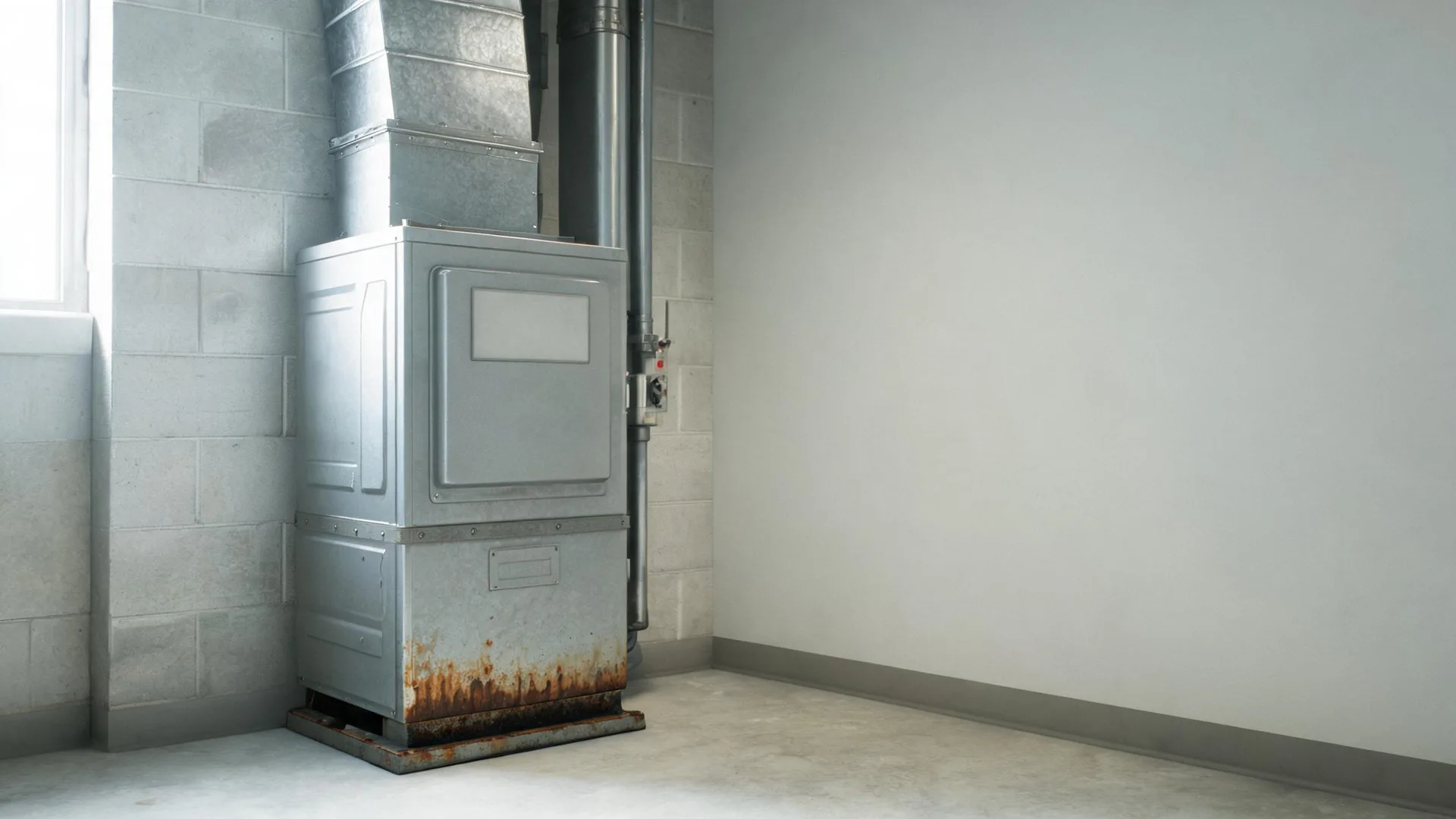
A gray residential gas furnace installed in an unfinished basement, surrounded by ductwork, a metal flue pipe, and a gas supply line.

What to check before the panel comes off

Before anyone comes out, check the thermostat first. Set to heat, and the temperature set above room temperature. If it runs on batteries, swap them. Next find the power switch on or near the furnace, it looks like an ordinary light switch, and make sure it wasn't bumped off. Check the breaker too. Pull the air filter and look at it. A filter packed with dust can choke airflow enough that the furnace shuts itself off to protect itself, and that alone can look like a bigger problem than it is. On a gas furnace, check that the gas valve is open and that other gas appliances in the house are still working. Outside, look at the vent pipe where it exits the house and clear anything blocking it, snow or debris. If there's a viewing window, check the flame. It should be steady and blue. Yellow or flickering means call someone, don't try to fix that part yourself. None of this means opening the cabinet or touching the igniter or burners. If the furnace still won't run after these checks, the problem is inside, and that's where it's time to stop.

Most failures are wear, not damage

A furnace has a handful of parts that do the same thing over and over each winter. The igniter heats up and cools down. The blower motor spins for hours at a stretch. The flame sensor sits in the flame path the whole time the burners run. None of them are built to last forever. They're built to last years. When one quits, it's usually because its time was up, not because anything was done wrong.

The same part fails in different ways

A cracked igniter might mean no heat at all. It might instead mean the furnace tries to light and gives up partway through. A flame sensor coated in residue can cause short cycling long before it causes a full shutdown. The symptom alone doesn't say which part is bad. It takes testing the actual part to know, which is also why swapping parts without testing rarely fixes it on the first try.

An unfinished basement featuring concrete block walls, exposed floor joists, and a metal forced-air furnace with ductwork near a central pillar.

A new furnace would cut about $50 a year off heating for a typical Otero County home.

  • A new high-efficiency furnace$210 a year
  • An older furnace$260 a year

Estimates for a typical Otero County home, compared with an older unit built to the previous federal minimum, from EIA household energy data, New Mexico fuel prices and NOAA climate normals. Your home will differ.

Repair makes sense when one part has failed and the heat exchanger is sound.

Replacement makes sense when the heat exchanger is cracked or the furnace keeps needing parts.

A furnace that's struggling will often still run, and that's the problem. A cracked igniter that's barely lighting the burners will keep trying, cycle after cycle, instead of failing clean. A blower motor running on a bad capacitor draws more current than it should every time it starts, which wears the motor down faster than if it just quit outright. A flame sensor reading a weak signal can let the burners light and shut off again and again rather than stop the furnace for good. Left alone, that kind of strain tends to take out whatever part was still fine. Catching the failing part early usually means a simpler repair than waiting until something else gives out alongside it.