

An unfinished concrete basement containing a metal HVAC air handler, exposed wooden ceiling joists with sheet-metal ducts, a hanging bare bulb, copper pipes, and stacked cardboard boxes.

Furnace Maintenance in Rio Rancho, NM

Tell us about the job

Takes about a minute. No obligation.

Tune-up, service, or cleaningFurnace or heatingSandoval County, NM
Step 1 of 2

What ZIP code is the job in?

A furnace usually tells you before it quits. Short cycling is one of the first signs, where it fires up, runs a few minutes, and shuts off before the house gets warm. A burner flame that's flickering or yellow instead of steady blue means it isn't burning clean. If a room near the thermostat feels fine but the far bedrooms stay cold, the blower or ductwork isn't moving enough air anymore. A burning dust smell in the first few minutes of a run is normal, but if it lingers or turns sharp, that's worth a look. Rattling, clicking, or a boom on startup usually means a part has worked loose or the igniter is struggling. None of these mean the furnace is done, but they mean it's due to be looked at before it picks the coldest night to quit.

Furnaces here start working in October.

Get yours checked in September, before it has to run.

75% of furnaces in Sandoval County run on gas, which means a burner to keep clean and a flue to keep clear

75% of homes heat with gas
Heat runs October through May
Winter nights average 19°F
Rio Rancho's furnaces are younger than mostHalf the homes in Sandoval County were built in 1997 or later

Once a year is enough for this. Sandoval County recorded 134 winter storms between 2015 and 2024, and weather like that is hard on the power grid more than it is on the furnace itself. When the power drops and comes back, the furnace fires up cold and has to prove itself again. A dirty burner or a weak igniter that was already borderline won't hold up through repeated restarts the way it might in a calmer year. One check before the season starts catches that part while it's still your decision to make, not the grid's.

Eight months of heat a year wears a furnace down. Check it before it starts.

Eight months of heat a year, down to a 19 degree overnight average in winter, is a long season to ask worn parts to get through. Have the furnace checked before October.

Find a contractor
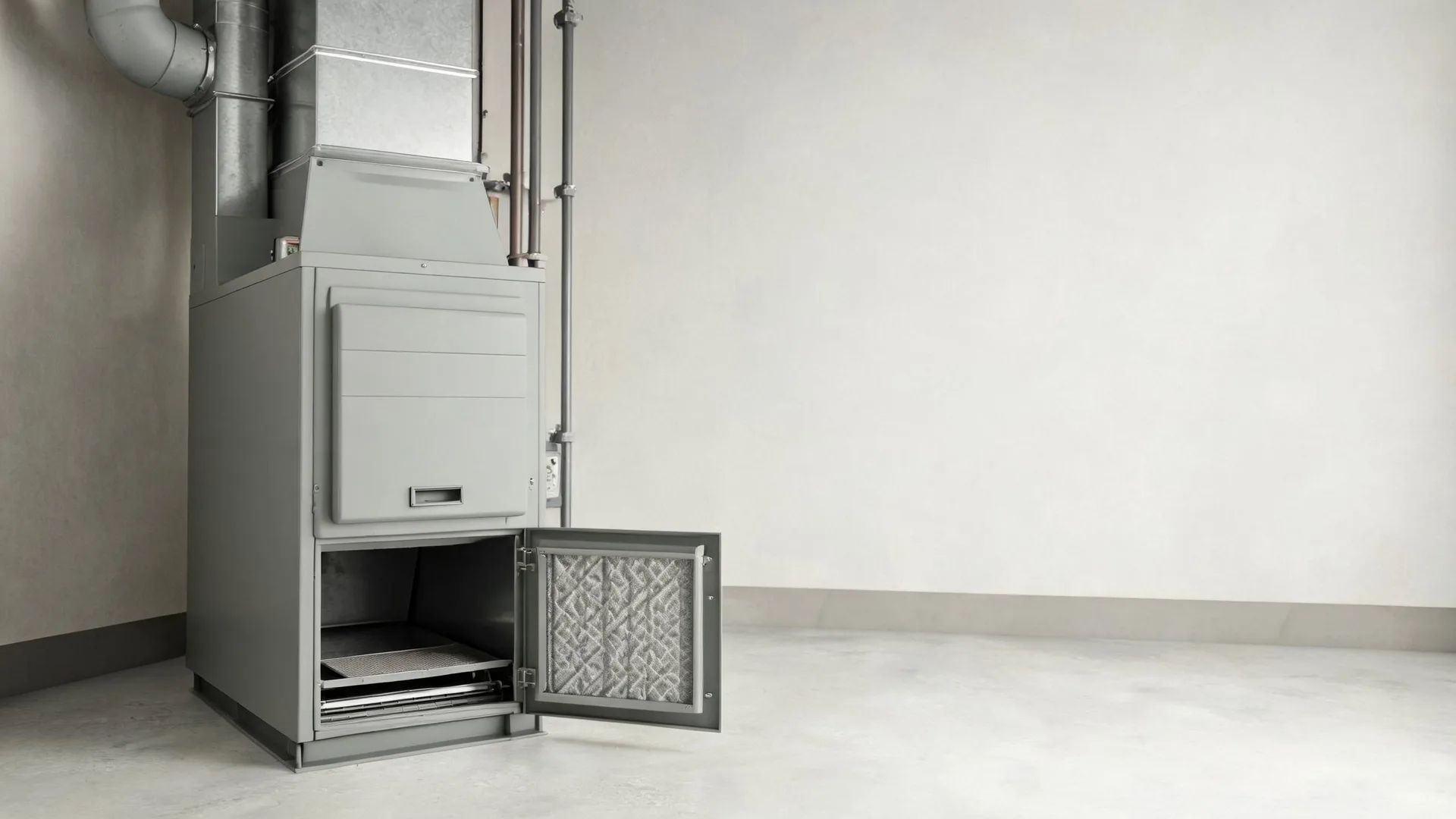
A gray residential gas furnace installed in an unfinished basement, surrounded by ductwork, a metal flue pipe, and a gas supply line.

What you can check, what you should leave alone

Between visits, the filter is the one thing worth your attention. Check it monthly during the season and swap or wash it when it looks gray and matted, not see-through. Keep the area around the furnace clear too, nothing stacked against the cabinet or blocking the return grille. If your furnace vents through a wall or roof cap, take a look outside after any heavy weather and clear anything blocking that pipe. Past that, leave the inside alone. The burner, the flame sensor, the igniter, those are a tech's job, and opening the cabinet to poke at them does more harm than good. What you can do is listen. A new rattle, a burning smell that lingers past the first few minutes, a flame that looks yellow through the viewing window instead of blue, those are worth a call before the next scheduled check, not something to wait out.

The filter is doing more than it looks like

A clogged filter starves the furnace of airflow across the heat exchanger. The burner keeps firing but the heat has nowhere to go, so the exchanger runs hotter than it should. Over time that heat stress is what cracks one. Swapping or washing the filter on a regular basis protects that part before it ever shows a problem.
The condensate drain only matters on certain furnaces

High efficiency furnaces produce condensation as they run, and that water has to leave through a drain line and often a small pump. If that line clogs with algae or sediment, the furnace senses it and shuts itself down rather than let water back up into the cabinet. An older standard furnace vents as a gas and doesn't have this part at all, so whether it applies depends on which kind sits in the house.

Skip the yearly check and nothing fails right away. What happens instead is slower. Dust builds on the burner and the flame stops burning clean, so the furnace works harder to put out the same heat. The flame sensor picks up a film that keeps it from sensing the flame properly, and the furnace starts shutting off mid-cycle for no reason anyone in the house can see. The igniter weakens a little more with each startup until the morning it just doesn't fire. None of this shows up as a single breakdown. It shows up as a furnace that runs longer and cycles more, right up until the part that was already failing finally does.

A proper tune-up starts with the burner. The tech pulls it and cleans off the rust and dust so the flame burns steady and blue instead of yellow and uneven. The flame sensor gets cleaned or tested too, since a film on that rod is one of the most common reasons a furnace fires and then quits a few seconds later. The igniter gets checked under load, not just looked at, because a hot surface igniter can look fine and still fail to get hot enough to light the gas. The heat exchanger gets inspected for cracks, since that's the part that puts carbon monoxide into the air you breathe if it fails. The tech also checks gas pressure at the manifold, tests the limit switch that shuts the furnace down if it overheats, and makes sure the blower motor and wheel are clean enough to move the air they're supposed to move. Each of these is a small thing on its own. Skipped together, year after year, they're what turns into a furnace that won't start on the coldest morning.